
10 January 2011
Photos with kind courtesy of Pat Bromilow-Downing
 “Sophie Sheridan” played by Caren Pretorius
Denis Hutchinson was the South African Associate Lighting Designer for the punchy production of Mamma Mia! which ran recently at the Artscape Theatre in Cape Town and the Montecasino Teatro in Fourways from the 2nd October 2010 to 2nd January 2011.The show made use of over 80 Vari-Lite fixtures.
Critics and fans alike have praised the South African performers and Denis in particular has made mention of the local crew. “I think we have what it takes to pull off a franchise musical,” commented Denis. “We have some very good crew who are able to move a show as fast as international crews.” Denis has worked with crews all over the world and says, “Our guys may lack the formal training, but they have a good work ethic and learn fast.”
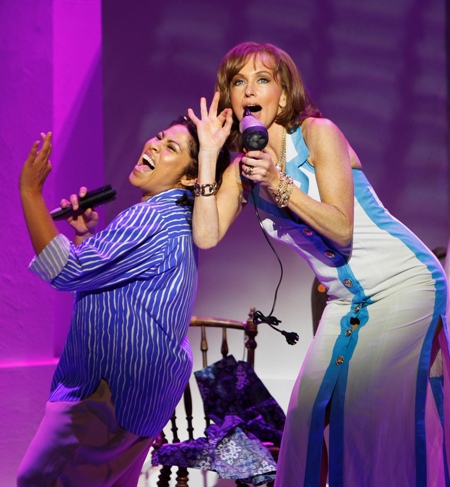 “Rosie and Kate” played by Kate Normington and Ilse Klink Gearhouse Splitbeam were the rigging suppliers for the production, supplying and rigging all the lighting trusses including the white trusses that are used in the finale of the show. “We also rigged the side towers and some set elements for the show”, said Alistair Kilbee, Managing Director of Splitbeam who was Technical Director for Mamma Mia!
Being one of the biggest selling musicals in the world, the production requirements are specified very precisely. Denis saw Mamma Mia! years ago in London. “I was never really an ABBA fan but was offered a house seat, and I happened to sit next to Björn Ulvaeus who was in to take notes. I had a lot of fun watching the show and his reactions to it as well!”
Alistair Kilbee agrees, “I was the Technical Director on the production which meant overseeing all technical aspects of the production, from sound, lighting, rigging, set construction, prop manufacture and crewing of the show. It was my job to make sure the show maintained the highest standards every night and that the audience got the same production value they would have if they had seen it in the West End or on Broadway. It was also my responsibility to move the show from Cape Town to Joburg and make sure that all technical elements looks as good there as they did when the UK team where here for the initial opening in Cape Town. “
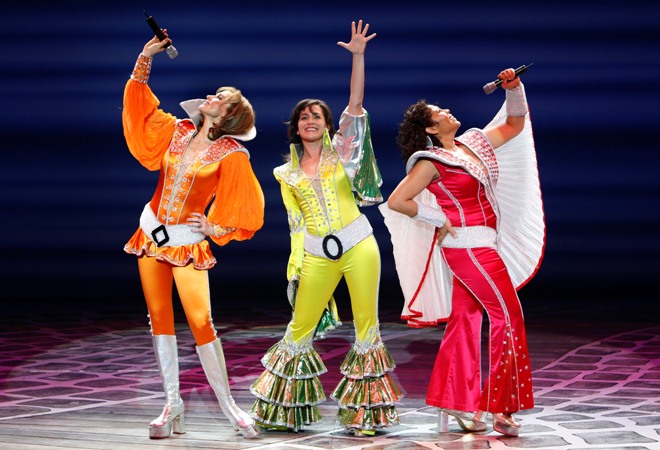 “Donna and the Dynamos” – Kate Normington, Gina Shmukler and Ilse Klink “The show had a local operator/production electrician, Moegamat Cloete from day one,” said Denis. “He learnt the rigging side from Martin Chisnal who came out from London. My role was to learn the design side from Andy Voller.” The lighting rig consisted of the following fixtures:
24 x Vari-Lite VL 2000 Spot
26 x Vari-Lite VL 2000 Wash
18 x Vari-Lite VL5
18 x Vari-Lite VL500
2 x Vari-Lite VL3500
4 x Martin MAC 2000 Spot
4 x Martin TW1
ECT Source Fours
Wybron Scrollers
LED Cyc Lights
Lycian 3k Followspots
1 x Vari-Lite Virtuoso console
“That’s a fair bit of kit, and one of the advantages of the current slew of franchise musicals is that local designers like myself get to play with equipment we ordinarily wouldn’t have access to,” said Denis. “On the other hand we are not getting to create our own productions which is frustrating not only for designers and directors, but also I think for producers who are trying to compete with scale of numbers against them.”
He adds, “On the third hand(!), there’s something quite interesting in being about to sit back and watch someone else do things (and take the pressure) while you learn the show. Those of us who work in the industry very rarely have the opportunity to watch others work and I find it fascinating to see processes different to my own at work. And where they’re better than mine, I have no shame in adapting them into my work process down the line.”
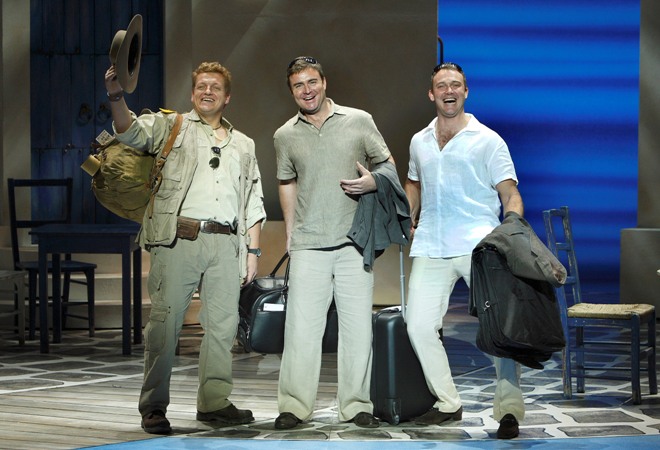 “The possible three dads” – Murray Todd, Anrich Herbst and Neels Clasen Lighting of the show is unobtrusive and largely in white and pastel colours with lots of gobos and play of shadows. The set is simple, helps the feeling of being on a small Greek island. Excellent performers and the familiar songs of ABBA work together to create the ideal feel good production. The upbeat finale includes two trusses above the stage, equipped with white VLs, lowered down for a splash of adrenalin and colour. “It looks gorgeous,” said Denis, “and the white fixtures certainly carry through the feel of the show.
“I enjoyed the VLs,” commented Denis. “I think the VL2500 is a great theatrical light. It is compact, which helps when doing musical where grid space is always at a premium and you have to hang fixtures in as compact an area as possible. The output is exceptional and I like the broad zoom. The VL3500 is a kick-ass unit; its shutters are phenomenal.”
There was some apprehension about the show running on a Vari-Lite Virtuoso console. Both Denis and Moegamat Cloete had a crash course on the desk, but there were reservations about it being the only desk of its kind in the country. “There’s nothing wrong with the desk,” said Denis, “but it is very unforgiving. It never asks if you’re sure about an action, it just does it, so anything is possible if you hit the wrong button!”
Andy Voller, the English Associate Lighting Designer for this production of Mamma Mia was the original moving light programmer in London. He trains Virtuoso operators and is naturally very comfortable with the desk, so Mo and I had good, if fast training. “I would still have been more comfortable running and transferring the show on GrandMA, but with operating manuals at my side, the Virtuoso behaved and did the job.”
“And of course, how much you have to play on the desk on a transfer comes down to how well you’ve done your homework,” remarked Denis. “If you hang the rig in the new venue exactly as it was in the previous one, there should only be minimal tweaking to do. Where differences are unavoidable – FOH positions and throw distances – always try to do the compensation at the lamp end by making sure you alter beam angles and wattages correctly. Get that right, and all you should have to do is tidy up moving light positions.”
Denis stayed involved with the show to ensure a constant quality. “I looked in on the show every four weeks,” he said. “The crew don’t have eyes everywhere and sometime problems creep in that can’t be seen from the control booth so it’s important to have someone sitting in the house regularly. It’s not about fault-finding but rather about supporting your crew and helping them to maintain the standard set on opening night.”
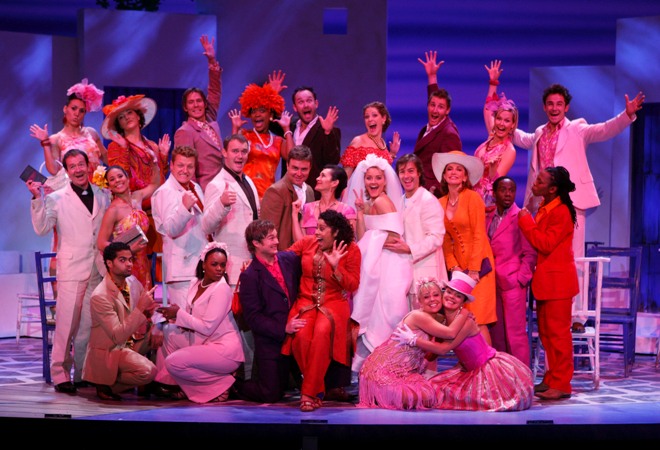 The wedding scene Alistair Kilbee ends, “Mamma Mia is the biggest selling musical in the world. We had a large number of crew come out from the UK for the first load-in in Cape Town. Most of them have done the show many times which can be helpful but can also make it harder for the South Africans to put their stamp on it. Of the shows I have worked on, Mamma Mia is the one that I think has the widest appeal as 95% of the audience every night know all the lyrics to the songs. There are moments in the show that I really love and others that I don’t, but all in all it is a very good night out.”
To the South African cast and the superb crew, take a bow!