
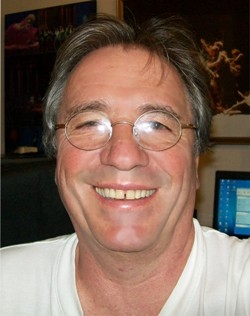
How much water has gone under the bridge in the South African theatre industry. Back in the day, you could start off as an usher and climb the ladder to become one of the country’s top lighting designer… one only has to think of legendry Mannie Manim who started his career as a doorman at the Brook Theatre. There was no technicon or educational institution to study lighting, but you learnt as your worked in the theatre, taught by the previous generation who may not have been flamboyant, but were a class who were particular in how things ought to be done. Nic Michaletos is a respected lighting designer and consultant from his own company, Nicklelight. Prior to that, in 1981 he was the founding director of Production Projects, a lighting and theatrical company, where he stayed until 2009. Get yourself a cup of coffee, pull up a comfortable chair and hear his story.
“My grandfather came to South Africa from England and married a German girl,” explained Nick. “My mother has Scandinavian roots, and the Greek part is small… other than the name. But it’s great, as when I get a bit vivid I can say it’s because I’m Greek.”
Nicolas was born in Pretoria and his father, grandfather and uncles were in the catering and restaurant industry. As his dad regularly relocated to open hotels and restaurants, Nic ended up attending various primary schools but completed his secondary education at Pretoria Boys High. “Catering is the other performing art,” said Nic. “It’s all about entertaining people, a tough game and 24/7.” Having studied and enjoyed art at school, Nic planned to become a photographer. He, along with a group of pals, conjured up grand ideas to visit Europe. Nic believed the trip would simultaneously afford him the opportunity to produce a picture anthology of the voyage. “To do this, one needed money, something I’ve never had enough sense to accumulate,” he smiles. It was around 1969 / 1970, and to raise the necessary funds, Nick worked at a steel factory. It was the most arduous work of his life – he has a license to operate a 50 ton crane as proof of the exercise! 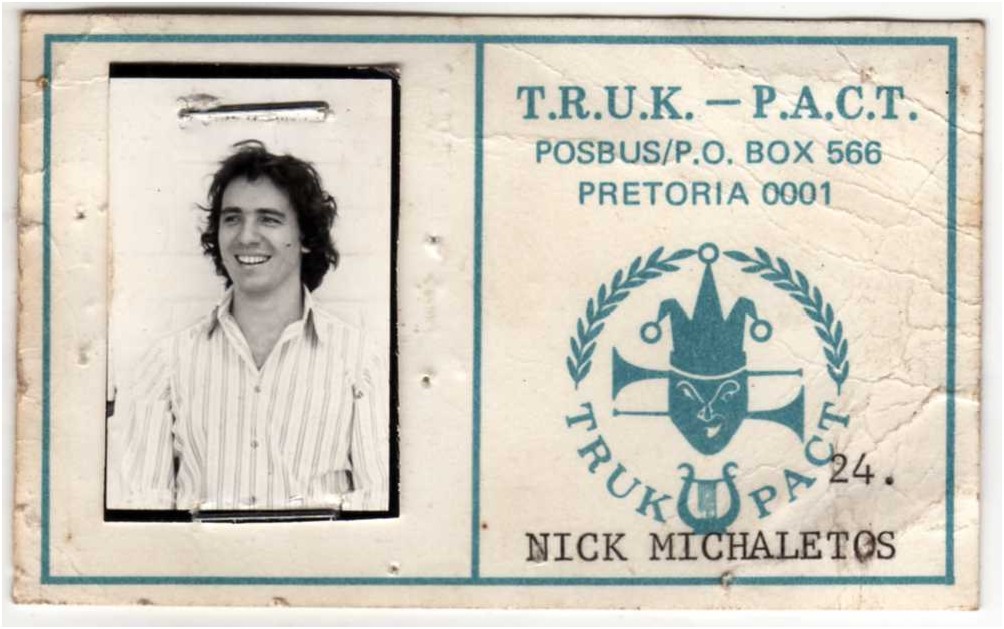 That December Nick resigned, paid for his ticket that would leave for Europe in June the following year, and had a holiday in Durban. “I had to keep myself occupied for the next few months and got a job at PACT Ballet Company through a friend of mine who was working there,” he said. The South African Ballet Company formed in 1963 at the behest of the South African government. It incorporated the old Johannesburg City Ballet, and took its name from its sponsoring body, the Performing Arts Council of the Transvaal (PACT). PACT also included the English and Afrikaans drama companies as well as an opera company, a ballet company and an orchestra. Nic took on the position as Assistant Stage Manager, a job of loading trucks, setting up and really doing it all. “I got into it and thought, this is for me,” he remembers. “I gave my plane ticket to a friend as a wedding gift.” As it has turned out, Nic has done more than his share of travelling since. “If I look at kids today, they haven’t got those windows of opportunities we had, working on big operas and the variety of shows that came in, I was very lucky” The 1970s was a busy time for the PACT Ballet Company. As it was given national subsidies and funding from the Department of Education and the Provincial Council, PACT toured, visiting schools across the country and provided small productions throughout the platteland. Nic was an ASM for the Ballet company. A couple of years later, Nic took on the position of Junior Lighting Technician at the Civic Theatre. “I worked under George Bush and Ronnie Doorman, said Nick. He says that Ronnie later joined the SABC where he enjoyed a long and successful career. “The Civic Theatre in the seventies was the platform for all kinds of shows including operas, ballet, musicals, extravaganzas and even the odd corporate event. George Bush was hands on, technical and a good teacher.” Nic remembers George being specific on how each light was hung for each show and this turned out to be a condensed learning phase for the young apprentice. George Bush trained Nic to have good habits like regularly bringing down the lights to clean them. “When they closed the Civic to revamp many years later, it was in the same condition as when it had first opened. The stage was immaculate and this attention and detail is something you get taught.” “I also worked with Harry Ligoff,” Nic recalls. ”He used to build his own dimmer boards, they were basic electrical devices but did the job. Even when he was much older, (at a guess, in his 70’s), Harry never lost interest and was always up-to-date with the latest electronic development.”
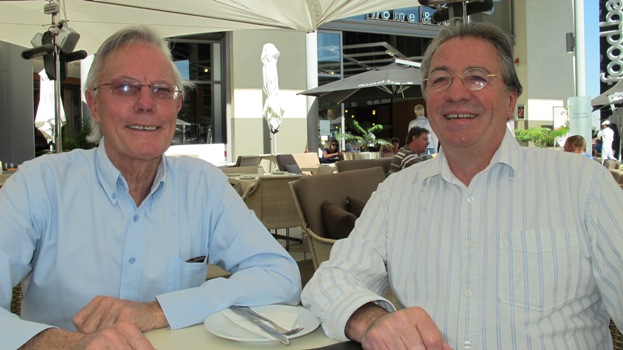
Stepping back to the future, Nic takes a sip of his cappuccino as he sits at a restaurant at Design Quarter, along with Dan Riley from DWR Distribution, telling the story of his life. He feels embarrassed to do so, emphasising any accolade he ever received was as a result of a team effort. “It feels strange to be singled out, when the reality is that any achievement in this game is the result of a much bigger collaboration,” he says and adds, “A producer or production company assembles a team, with a star out front (on stage) and a gang of people in the background providing the support that is necessary. That’s what we do. It’s never just you. I light shows with inputs from the director, set designer costume designer and so on, but when you get it right and you know that this will be one of those shows, that’s it right, there; the reason we keep on doing this job…it’s such a grand moment.” . One of his favourite and most serene moments is sitting in a dark auditorium preparing to start lighting a scene on the stage; “It’s scary while at the same time exhilarating, the beginning of a journey that you have done many times but always surprisingly different every time.” “Dan, this reminds me of the days we had with lunch meetings, informal and very entertaining,” he says. Nic recalls the first time he actually met Dan. “It was one of the first seasons that the ballet came to the Civic. There was something wrong with the dimmers, which were out of reach. George Bush said, ‘Just call Dan’. Dan became this iconic figure to me, who then worked for G.E.C., the General Electrical Company, the distributors for Strand at the time.” Thereafter, Nic became a resident lighting technician at the Aula, a small theatre in Pretoria for some three years. After this, Nic joined Joan Brickhill and Louis Bourke, when they revived the His Majesty’s Theatre in downtown Joburg. Joan and Louis were the largest independent show producers in the country at that time. They were famous for producing fantastic musicals and extravaganzas. This was when Nic first came to meet and work with Joe Freedman, probably the most respected technician of his time. “Joe is great; he knows more about the lighting process in the theatre than anybody else I know, plus he is also the only guy I know who knows all the lyrics of all the musicals he has ever worked on, and that’s a lot!”. Nic then rejoined PACT as a Senior Lighting Technician, and was part of the original technical team to open the ‘Pretoria State Theatre’. After the State Theatre had opened the posts of ‘Production Manager for Ballet, Opera and Music’, were added to his lighting duties. On a day, still whilst working at PACT, Nic was approached out of the blue to light a fashion show. “I had no idea about this kind of work, but the client was persistent,” explained Nic. Nic’s assistant at the time, Jan Luining, advised him; ‘Quote an exorbitant figure and she’ll go away.’ It turned out that I had no idea of how much ‘exorbitant’ was and that that the client would turn out to be one of the top fashion producers in the country.” She accepted the quotation and Nic had to get permission to hire gear from PACT to pull off the show. He also had to hire a combi and did the set up and run of the show by himself. Pretty soon Nic was earning more money freelancing then his actual salary, “Which was not to say that it was a large sum of money, just more than my PACT salary. I realised that this had to have some potential as a career.” He consequently resigned from the State Theatre, who refused to accept his resignation. When another freelance job came up, Nic asked Rudi Kestling, who was also working at PACT, if he would do it for him. “After the show, Rudi came to me with the money and after we had paid PACT for the rental of the gear, I gave half the amount to Rudi.” Rudi could see this may be the gap he was looking for as well, and the pair, who both at the time had young families, handed in their resignations to the Director of PACT / State Theatre. “I remember him saying, You do realize we’re heading for a recession,” said Nic. The year was 1981and Production Projects was born, along with the third partner, Paul Pamboukian. Production Projects received R1 000.00 payment for one of their first jobs. “We were throwing the money around the car as if it were confetti,” smiles Nic.
“If I look back at how much we didn’t know! And then the thing of not getting paid was a massive problem!” At one gig the client had not yet paid and during set up in the afternoon, Nic and Paul threatened not to run the show. “The client asked that if he paid us cash, would he get a discount?” Apparently the money was being collected at the door from the entrance fees!
Nic remembers Paul Pamboukian saying to him, “What will we put the money in?” And they contemplated a suitcase, eventually deciding that a shopping bag would do the trick. The show was done and as it turned out, the client did not pay cash. Later, when asking their accountant how much space R15 0000 would have needed, and how they would carry it, he replied, “Oh, your jacket pocket would have done it.”
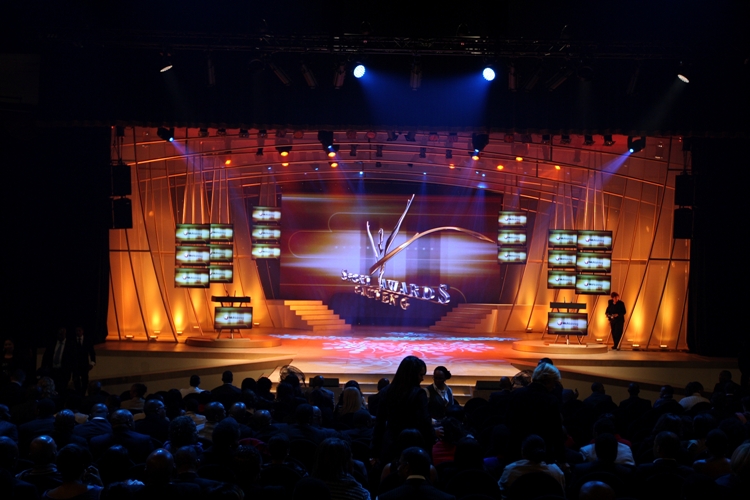
The company had phenomenal growth for several years once they had opened, and one of the reasons was that up to then, the only lighting rental companies were film lighting companies, nobody was providing a properly theatrical service for live entertainment in the corporate market. “We were also lucky that at about that time Sun International were embarking on the ‘Extravaganza’ shows at Sun City and the Wild Coast, these needed all sorts of custom wiring and special effects lighting, so we were right there at the right time, which was one serious learning curve,” he said. This exposure also led to Nic being offered several lighting design contracts for the shows. Some of Nick’s fondest memories or milestones were in the PACT days and having the opportunity to work alongside good directors like Ande Anderson from the English National Opera. You learn so much from someone like that,” said Nic. On many occasions he worked with the set designer, Tony Farmer. “He would design such huge exotic opera sets for a stage so small, that scene changes had to be choreographed scene for scene. The set pieces had to be stacked in particular sequences to facilitate the changes. Sometimes a single piece would move 3 times backstage before it was due to come on in the last act.” Barry Snow, who was the senior stage manager for the opera company, was a master of planning these sequences. Derek Swanepoel was senior stage manager at the ballet company and Jannie, his brother, was in the drama company, the stage managers and the crews for the various companies were amazing, huge energy and commitment.  Another highlight was Nic’s involvement with Queen at the Opera. Essentially the play was created to fill a cancelled slot at the Natal Playhouse. Jeff Sutherland was artistic director of the Playhouse company at the time and the project was his solution. Nobody expected the show would be a big thing. “They asked Jeff to put something together for 2 to 3 weeks. It was called ‘Queen at the Opera’ as it was held at the Opera House. Andrew Botha was the set and costume designer. This was one of those moments when the synergy between everybody worked incredibly well and the end result was a show that just exploded. “ It was so successful that a second ‘Queen’ show was conceived. “It opened two weeks after Freddie Mercury died,” said Nick. To some the impression was that it was a sleazy stunt, but preparations for the show had been ongoing for the past year. Sadly, shortly after that, Jeff died. “The third show, which started the productions touring phase was staged at the Standard Bank Arena. It played to ¾ houses, but this still meant that more people saw the show in the week it ran, than if it would if it ran to sold performances for 3 weeks at the Civic. Over the next two years the show then went on to Cape Town, Bloemfontein, Pretoria and to the Jhb. Civic also including a final and 3rd season in Durban.
  On a personal note, Nic met his wife Frances in 1974 when she was assisting backstage at an Opera. They were married about six months later. “Frances started as a graphic designer and then moved to costume coordinating and then designing,” he said. She has received various awards for her designs over the years, but possibly her greatest achievement has been bringing up the couple’s two lovely daughters, the older a teacher who now works with her husband in their engineering and consulting company and the younger, an amateur dancer who is also a GIS Mapping programmer. When Production Projects was established, Nic’s wife Frances worked as the bookkeeper. “For the first five years she didn’t get paid,” recalls Nic. “Frances’ tuition included going to Art School and she is very in sync with balance and colour. We can watch a show on television and she’ll say, ‘that guy in the chorus line is wearing the wrong socks for this scene. That’s the secret of this business… detail. I tell you, she really is special; she has been my anchor in stormy times and an inspiration to her family, I honestly don’t know what I would have done without her support over the years. The amazing thing is that she has put up with me, can’t have been an easy ride.”
  As for Nic’s hobbies, personal life and work have intertwined, doing what he loves to do. He also enjoys reading and loves music, albeit with a somewhat eclectic taste, (classical to deep groove lounge beats) it does happen that he will dabble at painting, “This is extremely rare but when the desire and opportunity converge, it is a treat.” Having travelled the world, Nic has come to the conclusion that a hotel is a hotel, wherever you go, and a theatre is a theatre. “Even when working in a theatre where you can’t speak the language, it’s the same type of people working there wherever you go.”
Highlights Nic has enjoyed, with courtesy to the TPSA website for this information:
Opera: Tristan & Isolda (State Theatre), Lohengrin, (Dbn, Jhb, Ct & Pta) Tannhauser (Cape Opera) Artexerxes, (ROH London) I Puritane (State Theatre). Ballet: Swan Lake, Rosalinda, Papillion, 3Musketeers, Sleeping Beauty, Gisselle, Anna Karennina. Musicals: Great Waltz, Showboat, Jukebox Jol!, Queen at the Opera, Jesus Christ Superstar. Extravaganzas: Fun n Games (Sun International), Stars (Sun International), ‘Movin’ (Sun International), Fantastaca! (Malaysia), Events: Miss South Africa, Miss World, Namibia Independence Concert, Mandela Rainbow concert, Mandela birthday banquet, SAA 50th anniversary, Klein Karoo Arts Festival: As for the past 14 years, since its inception, his company Production Projects supplied all lighting controls, dimmers and power reticulation for Klein Karoo National Arts Festival, up until 2009, NM was contracted as the principle lighting coordinator for the festival, which is now the largest of this genre staged in Africa.  Published: 15 September 2011