
22 October 2009
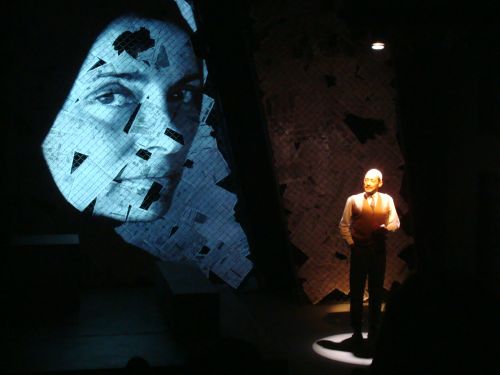
Denis Hutchinson designed both sets and lighting for Brothers in Blood at the Market Theatre using the new Robe DT 3000s – a first for South African theatre – as well as a grandMA full size console. DWR Distribution will attempt to capture all Hutch had to say during a recent interview, as we without question, could not word it better ourselves. We thoroughly enjoyed hearing how Robe technology brought a new dynamic to the production and set design.
Sitting informally in the DWR demo room, somehow having found the time to be there despite a schedule second to none which includes being associate LD on CATS at Montecasino, Hutch appears relaxed at least. He sips what he calls a cheap round: black, sugarless tea, while talking about the production.
“Brothers in Blood deals with very emotive issues; it’s set in Cape Town in the nineties and deals with people trapped in the crossfire of the vigilante groups of the time of which Pagad was the best known. Author Mike van Graan (himself a Capetonian) has taken five characters with contrasting backgrounds and placed them in conflict with one another within that time. The interaction between the characters in this context makes for an interesting piece. It is dark and not happy but in the end you realize that we’re all in this together. The planet turns with or without us, and as long as we’re here, our differences are fewer than our similarities.
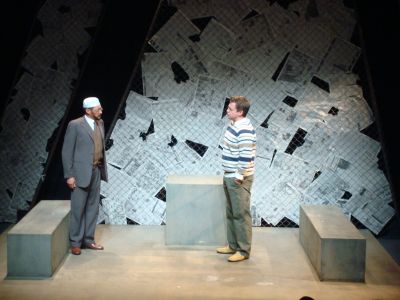
I’ve known Greg Hamonn, the director; for a long time but it was the first time we’d worked together and it proved to be a really good working relationship. Brothers is a difficult piece because (at least in draft form) it’s a screenplay rather than a play. It moves rapidly from location to location and both forwards and backwards in time with impossible costume changes, and while this may be easy to do on screen, it is fiendishly difficult to do on stage. We were faced with how to take a piece like this and make it work practically and then still fit within a budget somewhat smaller than Mr. Spielberg works with. Mike had also indicated that he wanted footage from that period to be utilized, but had written it as a backdrop which I felt was a bit passé.
After a lot of playing with ideas on my own, I called Greg one day and said: ‘Neither of us can do this alone – we have to work together to solve both the scenic and staging problems at the same time.’ This led to a marathon session where we literally went through the piece together moment by moment exploring our options along the lines of, ‘If we do this we can do that, but then…’
 Somewhere in the middle of all this, I recalled the demo I had been to at the launch of the ROBE DT3000s. At the time I was more impressed with the units as a tool for a set designer than I was with their potential for lighting, but I now realised that here was a possible solution to the design concept for Brothers in Blood. Problem was could we source the gear within the available budget?
After my session with Greg, I approached Carl Johnson from the Market Theatre and explained to him what I was hoping to be able to do. I described what the DT 3000s could do and how they could work for the theatre beyond this production as well. He asked some probing questions applied to applications beyond Brothers and became very excited at the potential for several regular requirements at the theatre. Problem was, no matter how we fiddled the numbers, even one unit was stretching things and I wanted two!
I already knew Mark Gaylard, owner of the rental company MGG, had also shown interest in this product. Mark has been coming to the party with long run hires for theatres quite regularly of late, and I suggested to Carl that we approach him and see if we could make a deal. Mark looked at the cost implications, decided it could be worth his while and offered the units to us at an affordable price. Well, affordable if I could bring the physical side of the set in very cheaply!
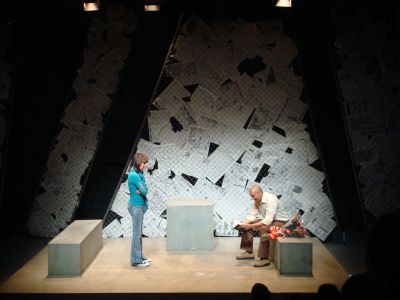 One of the most exciting features of the DT3000 is that it allows you to shape the image in ways that are not rectangular. Life does not happen in 4 x 3 format and that has always been one of my irritations with onstage projection. Now, for the first time it is economically possible to conceive projection beyond normal aspect ratios (I love picture merge!), and to shape images to suit. In this case, the set comprised four screens, all irregular in shape. As the piece takes place on the Cape Flats, I wanted a sense of the (nearly) continual wind that blows there, taking newspaper and sweet and crisp wrappers in its wake and then depositing them on fences. Hence, screens made of diamond fencing mesh with newsprint stuck on the back! Not a classy screen, but a really interestingly textured and cheap one.
The next challenge was to source the video material we needed. Liza Key from Cape Town had been contracted by the Market to source footage, and several long evenings were spent looking at images. Wine helps… As it happens there is very little footage of the period that we felt was suitable for the story we were trying to tell and we ended up using only stills. However these were cut to the score (which was specially composed for the play by Michael Watt) and as this was a primarily percussive score, the effect was sharp, fast, hard and surprisingly animated! This was further enhanced by a decision not to use colour but to keep a slightly grainy B&W newspaper feel to the images. But you’d be disappointed if I said that all we planned on doing was projecting images…
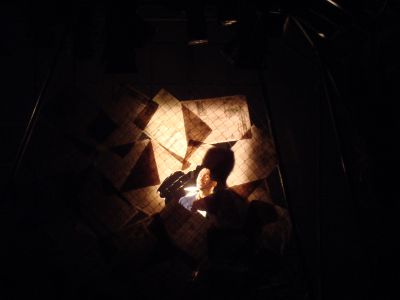
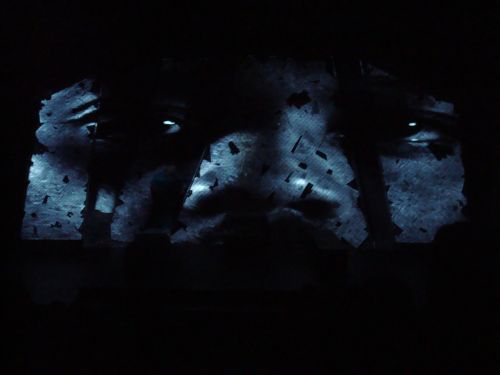 In the play one of the characters is making a suicide video. We felt it would be boring to see him standing in front of a camera, but if he stood in front of a giant version of himself as he was filming himself, that could be fun. Now ROBE will tell you that the DT 3000 it is not recommended for use with live footage, as there is a sound sync issue. They don’t say anything about asking an actor to lip synch live to his own filmed image while it’s behind him! Monitoring obviously became an issue, but a video monitor is a light source that was unwanted and so we ended up with a large mirror at the back of the auditorium in which the actor could see the projection. It took some rehearsal, but he worked hard and in the end his lip synch was spot on!
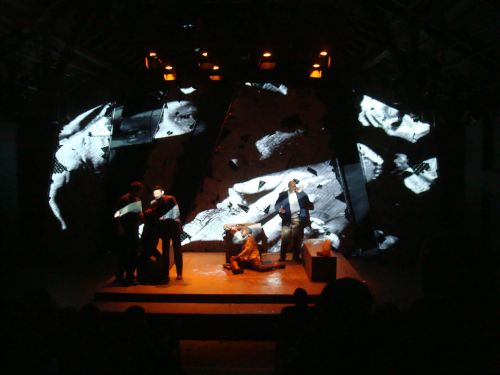
One of the joys of the DT3000s was the sophistication that they allowed us. Firstly, we could scale images to suit the moment: covering all four screens with a single image when we wanted maximum impact, or gently fading in an image on only one screen during a tender monologue when that was appropriate. Secondly, we could play with layers, mixing and even distorting images. Being able to overlay and to a degree edit in the theatre rather than in an expensive edit suite was a big plus, and I like to think that we achieved a marriage between what was required by the text, what the actors were doing and what was happening visually around them.
Of course, DT3000s need to be controlled. I chose not to use the house desk, as the rather large numbers of parameters used by digital moving lights would have left me no channels for lighting! Fortunately, DWR were keen to let me try GrandMA on PC and so lent us a two-port node for the run and a full size Grand MA for programming. Thank you Duncan! Once set up on the desk, the DT3000s proved very easy to program and we were up and running quite quickly even though this was the first time any of us had used them.
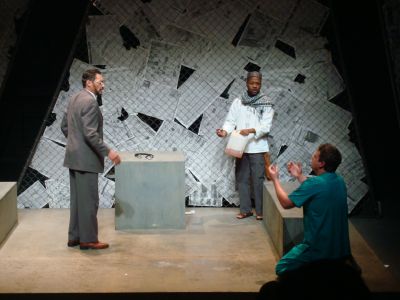
On one level we barely touched the surface on what the DT3000s are capable of, but on another level I think we pushed the usage of projection on stage quite far. Certainly for this country. I was very pleased and proud on opening night when the audience saw exactly what Greg and I had conceived on the stage. Far too often the final product is a pale reflection of the original concept and it was a rare pleasure for that not to be the case.
Both the play and production were well received; the strong emotional core of the piece moved audiences powerfully and ironically part of why we go to the theatre is to allow our emotions to be manipulated. It’s not something we’d allow in real life, but with suspension of disbelief when the house lights go down, it’s a time honored way of becoming involved in another world with all it’s fascination.”
Footnote:
– A sincere thank you to Denis Hutchinson for taking the time to meet with us, for his beautiful language and his passion for the arts and technology.
– The loan desk allowed the team at the Market to play with GrandMA software and they found the syntax relatively easy to learn and were impressed enough that not long after, they opted to purchase a GrandMA 2 Ultra-Light.