
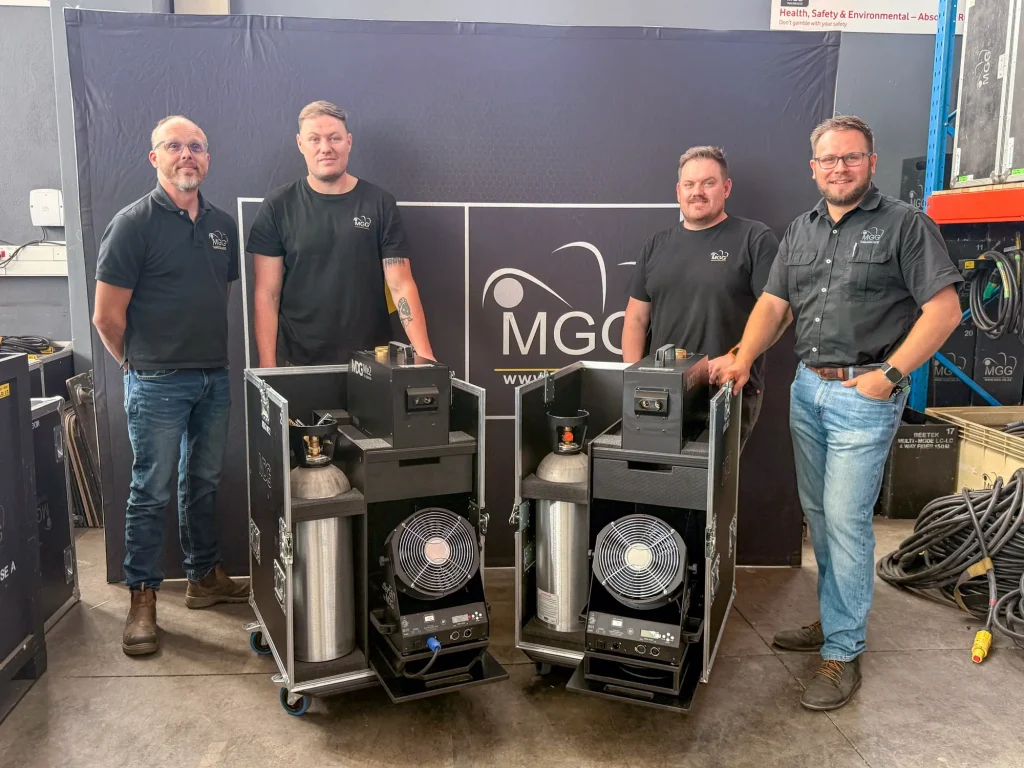
South African technical supply and rental company MGG has invested in two MDG Me2 Fog Generators from local distributor DWR Distribution. For larger shows and TV shoots, the new additions deliver fog that looks great in venues and, importantly, performs just as well on camera.
“We already have a good smoke and haze inventory, so it was really about adding something that would complement what we have,” says Nardus de Lange, Technical Manager at MGG. “We have many MDG hazers but thought it would be great to include a fogger.”
The MDG Me2 is a powerful, oil-based fog. It releases a dense, fine white fog that illuminates laser beams, moving lights, and wash fixtures mid-air. The Me2 delivers rich coverage, giving light beams a solid and clearly defined appearance. It offers variable fog output from 0–100% via DMX/RDM or local control, with low fluid consumption of 2 L per hour at maximum output. Its APS™ (Automatic Purging System) helps prevent residue build-up and clogging, while its dual nozzles deliver up to 200 m³ of fog per minute.
“Interestingly, compared to other machines, we’ve noticed a real difference in the colour of the light through MDG haze or fog,” adds Nardus. “The colours are so pure compared to other brands. It’s quite insane to see the difference.”
For Günther Müller, Project Manager at MGG, the value of MDG’s Me2 starts with the unit practically housed in a flightcase, and more importantly, it’s benefits when cameras enter the picture.
“You always have to find a balance between the lighting designer, who wants enough haze in the venue to make the lights look their best for the audience, and the camera team, who need clear visuals from their end,” says Günther Müller. “MDG is recognised worldwide for its camera-friendly solutions, and you can see the difference in the way the particles are formed.”
In addition, events and shows have changed. “Years ago, a production was seldom filmed,” says Günther. “It would typically be live to screen, and perhaps once or twice a year, you’d have an event filmed using an OB truck and big cameras. Today, almost every event, from small corporate functions to big concerts, becomes a full-on TV production. Technology has evolved so much that you can achieve quality footage with a small camera fly kit in a venue.
“We’re moving toward 4K as standard, so the camera captures so much quality and detail. If we don’t use the right fog and haze solution, it affects the audience experience and how the lighting looks on camera. If the atmosphere is too foggy and too dense, the image becomes flat, and the camera crew struggles to get the shots they need. MDG is the secret sauce, so we’re very happy.”
Looking at the running cost
MGG also took a closer look at the efficiency of its haze and fog fleet, with Nardus compiling a spreadsheet to compare the running costs of all the brands for one, two, and four hours.
“We always held back on putting MDG on shows because it was considered ‘too expensive’,” Günther explains. “When we actually ran the numbers, we found that MDG was actually the most efficient at the end of the day. The units we thought were the most efficient turned out to be the thirstiest.”
The findings led to a fresh perspective on how MDG Me2 compares with conventional haze and fog machines.
“It was a whole mind shift for us,” says Günther. We realised that traditional, older fluid-only haze and fog machines use more fluid during a production than an MDG unit. You would think that with the addition of a CO₂ cylinder it would be more expensive, but it is actually more efficient, running longer on a tank than solely on a traditional bottle of fluid. You also need less fluid because of the way the fog is engineered. You don’t have to pump out as much as you would with an older machine to achieve the effect you want.”
MDG’s quality and longevity, along with technical support from DWR Distribution, provided peace of mind when making the purchase.
“Our MDG units have been very reliable over the years, ends Nardus. “We haven’t had to do many repairs. We’ve simply had to prep the machines and load them onto the truck.”