
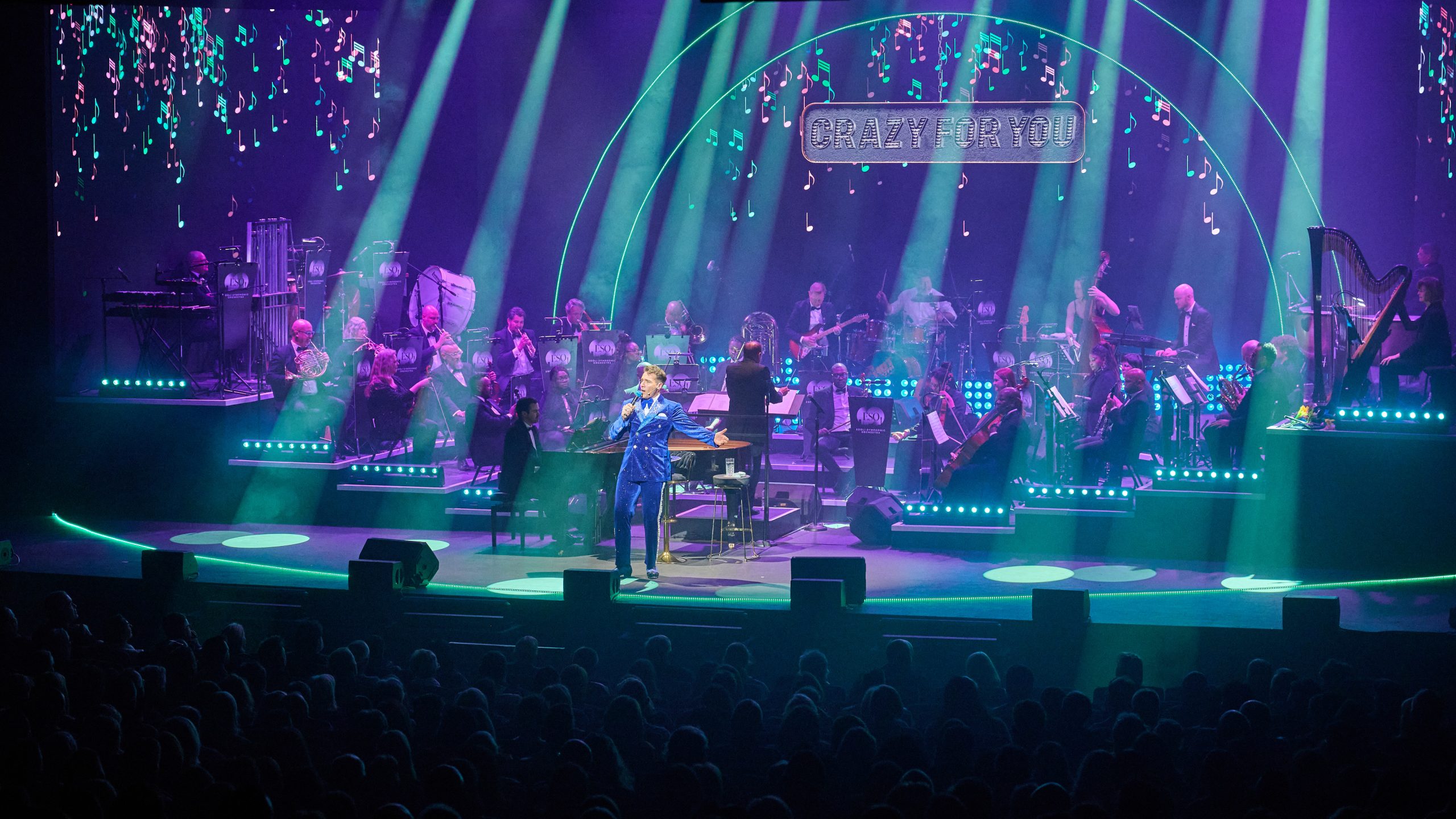
L-Acoustics’ L-ISA Hyperreal technology makes its South African debut, integrated seamlessly into a glittering tribute to the golden age of musical theatre. Peter Iantoro, TPiMEA Magazine, reports:
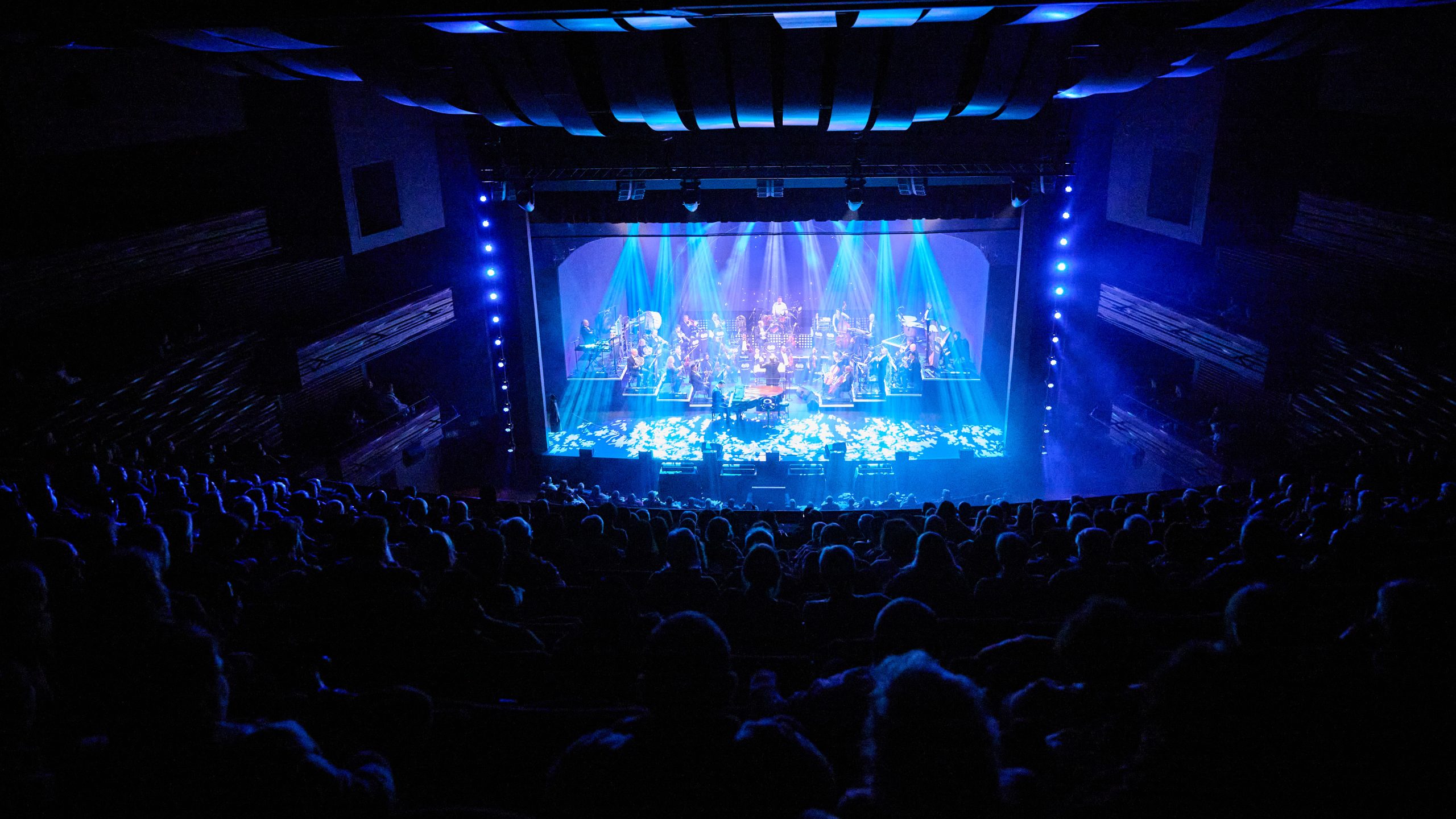
The South African live events industry has had to be patient when it comes to L-Acoustics’ L-ISA technology, with the COVID-19 pandemic putting paid to the efforts of early adopters. However, after a long and bumpy road, event design and production company Multi-Media led the way this summer, rolling out the technology on actor and singer Jonathan Roxmouth’s hugely successful My Favourite Broadway produced by Howard Events. Featuring the newly launched 32-piece Egoli Symphonic Orchestra, conducted by Maestro Adam Howard, the production proved to be a huge hit, with Johannesburg’s Teatro theatre close to capacity for each performance of the eight-show run.
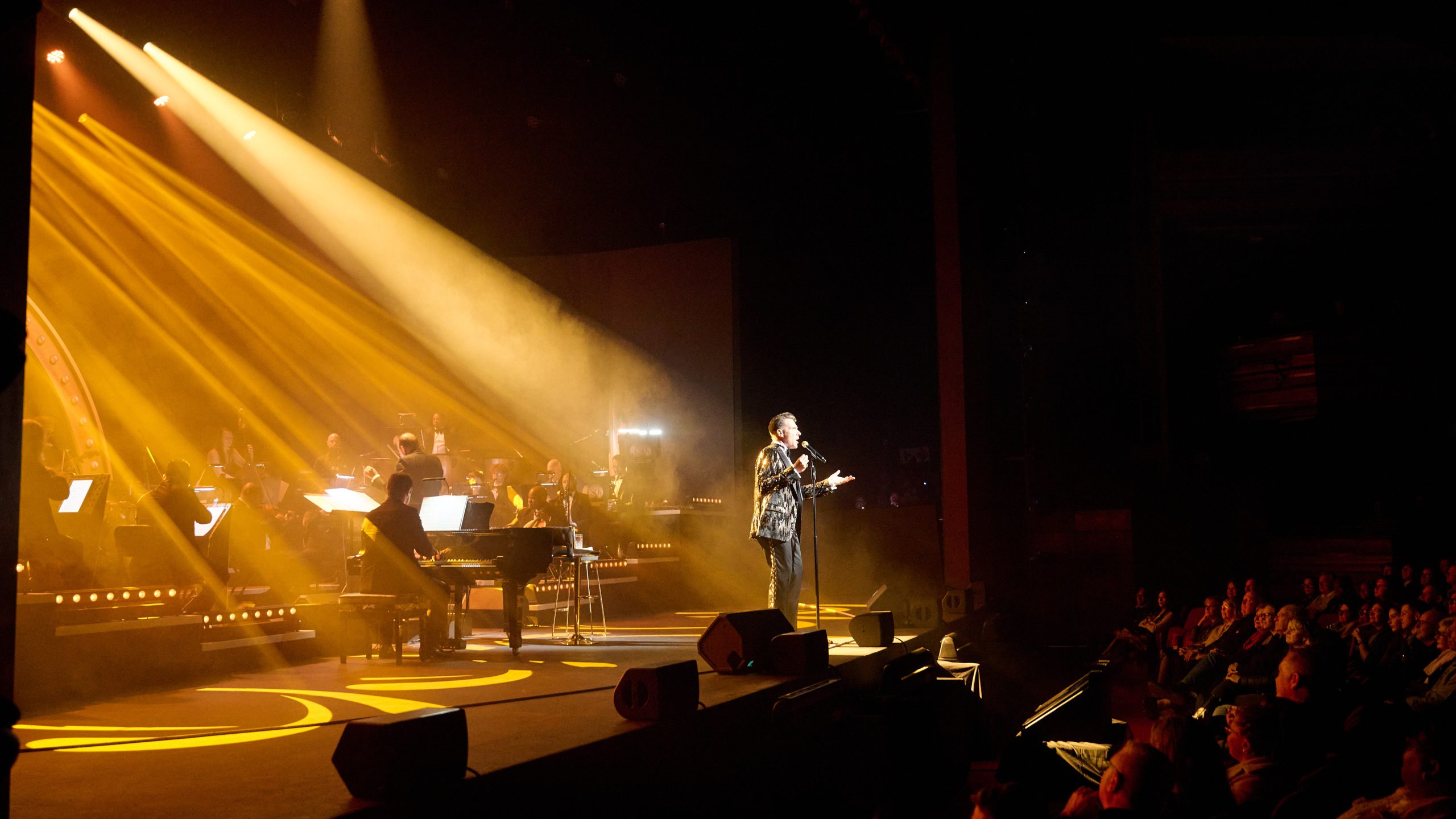
“We had been looking for an opportunity to get the L-ISA system deployed in South Africa for a long time, but we were aware that it needed to be the right project if it was going to make the kind of impact we wanted,” said Jason Fritz, Director of Production and Technical at Multi-Media, explaining the backstory behind the project.
An early adopter of L-ISA, Multi-Media had already invested in the equipment required. All that was needed was the right production to deploy it on and, importantly, the people with the training to pull it off. “This is where Duncan came in,” Fritz commented, referring to DWR Distribution’s Duncan Riley. “He drove the training side of things, arranging for 12 of the country’s top audio engineers – including three of our team – to come to our studio and do the L-ISA training.”
Riley in turn credited DWR’s Head of Audio, Richard Smith, who was heavily involved in the organisation of the training and supporting all parties in the lead-up to the project, as well as L-Acoustics Application Engineer, Adriaan Van Der Walt, who conducted the training course. “Adriaan came to facilitate the training, and his experience and expertise was invaluable,” he reported. “We were able to get 12 engineers certified and accredited, which means that it is now much easier for projects like this to be pulled off in South Africa.”
Alongside the training, plans were being hatched to integrate the L-ISA technology into Jonathan Roxmouth’s My Favourite Broadway show. “As soon as we pitched Jonathan and Adam the concept and played them the tracks in the studio, they understood completely,” Fritz commented. “The buy-in was immediate.”
One of the major benefits of having spatial audio was the ability to “put the sound where you see it”. Van Der Walt explained: “Using Hyperreal localisation, Jonathan’s voice could be tracked extremely accurately, while spatial unmasking allows the audience to hear each instrument and voice with much greater clarity and connect better with the music.”
While Musical Director Adam Howard had heard L-ISA in demo form before – and even owns his own Dolby Atmos studio – this was the first time he had experienced it in a real-life setting. “It’s so realistic in the way it presents a live performance – an orchestra in particular – where you actually don’t notice the technology,” Howard commented. “You don’t feel that you can hear the speakers in the room, which I suppose is the best way a piece of technology can be integrated. It was the best live sound I have ever heard involving an orchestra in my 28-year career.”
While the early version of the system was just a frontal scene, it soon grew into a fully immersive deployment as the project progressed. “That is when you really start noticing how incredible the technology is,” recalled Riley. “The effects started playing a major role, and you had people turning around wondering where the sound was coming from.”
The system featured 54 KARA II for the main scene, with 12 X12 for surrounds, seven X15 HiQ under the balcony for spatial fills, and seven X8 for spatial front fills, powered by a combination of 17 LA12X and two LA4X amplifiers.
FOH Engineer Morné Swanepoel manned a DiGiCo SD10, with a total of 77 input channels including instruments and Dante and 33 output channels for L-ISA, using an L-ISA Controller to manage the spatial audio.
“On the integration side, we included the L-ISA servers in the Optocore loop of the DiGiCo SD10s and used 33 inputs and direct outs for the backup signal for amp inputs,” Swanepoel explained. “For the main signal to the amps, we used an LC16D to convert MADI to AVB that utilised the existing network to distribute the main signal to the amps.”
Reflecting on the delivery, Fritz pinpointed the spatial front fills and smooth, even coverage of low frequencies as standout characteristics. “The feedback we received from Adam Howard was that this was one of the best systems he’d ever heard – like studio sound in a theatre setting,” he commented. “We also had several people – both in the industry and normal punters – approaching FOH to ask how it was done. Once you’ve experienced something like this, it’s difficult to go back to stereo.”
DWR’s Head of Audio, Richard Smith, was also extremely impressed with the system, having been fortunate enough to see the show several times during its run. “I saw the show with everyone from L-Acoustics representatives to many clients, including musical directors, church technicians, musicians, directors, and rental companies, and they all thought the audio was breathtaking,” he reported. “Every single person commented on how amazing it was to hear the instrument coming from where they saw it on the stage and they loved the tracking of Jonathan’s voice.
“This show was a brilliant example of the power of L-ISA to truly bring the audience into the performance,” he added. “I am truly impressed by what was accomplished in such a short time by the creative and technical team. A huge congratulations to everyone involved.”
‘Everyone gets excited about everything’
It’s important to note that the audio wasn’t operating in isolation. In fact, the production was fully integrated, with audio, lighting and video all tracking the artist in sync, using Modulo Pi KineMotion as the backbone. “Wherever Jonathan walked, the lights, audio and video would follow,” Fritz recalled. “It was an incredibly efficient and effective system.”
Delving more into the use of the Modulo Pi system, Lighting Designer Oliver Hauser explained how he accommodated it within his workflow. “We had a variety of infrared cameras on stage, and an infrared beacon that Jonathan wore on the back of his jacket,” he noted, going on to describe the pre-production process. “We had to set up the system in the 3D environment, making sure that the stage dimensions matched the real world exactly. Then it was the same thing from an MA perspective, and we imported an MVR [My Virtual Rig] and built the show in the 3D world.”
Hauser described the system as “almost plug and play” from that point. “We spoke to Modulo Pi via a PosiStageNet protocol, and apart from a few minor calibrations, it was super quick and easy to set up,” he recalled. “It was my first time using Modulo Pi and I couldn’t believe how simple and effective it was.”

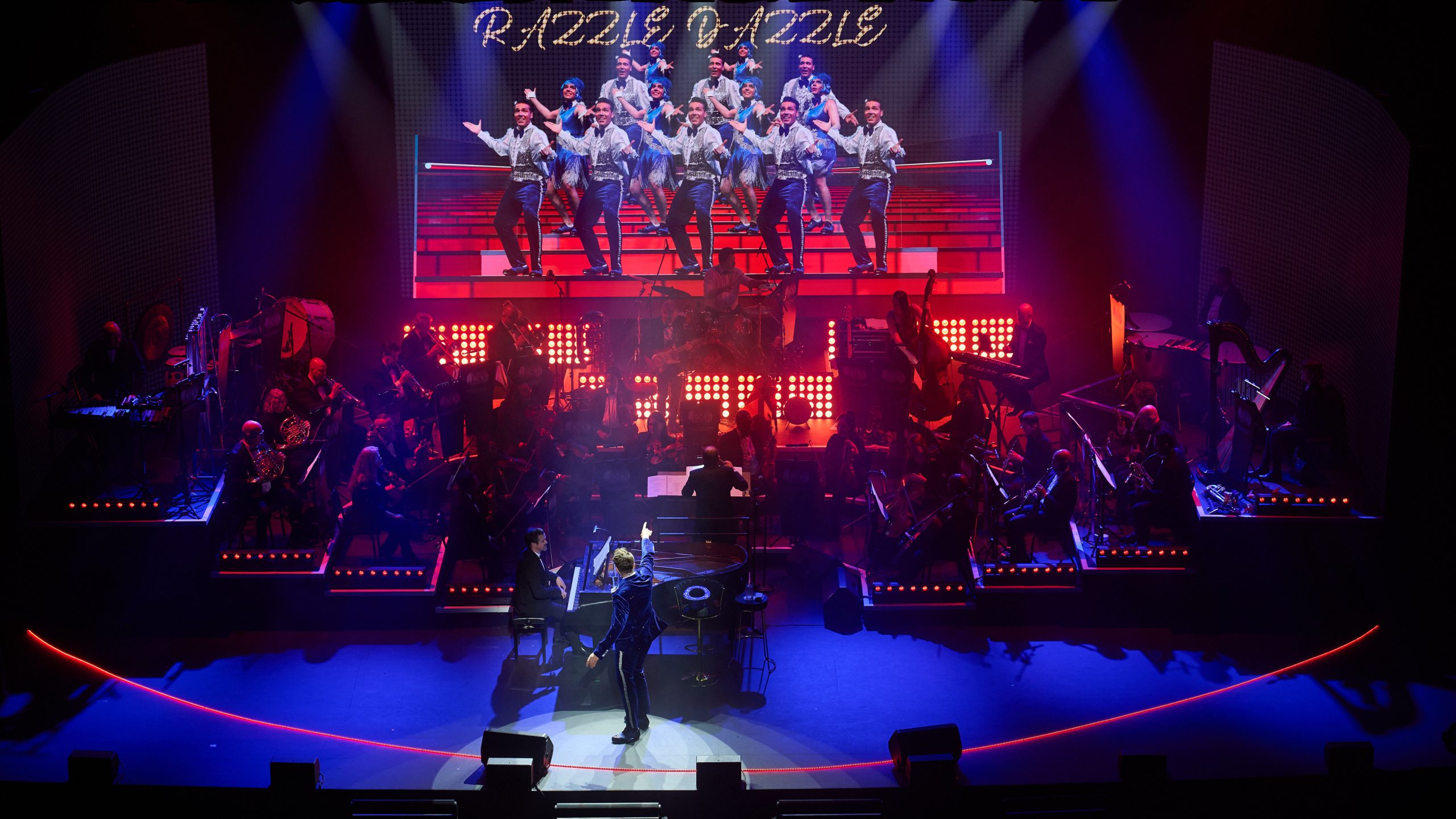
Having worked closely with Jason Fritz on several Howard Events productions, Hauser once again teamed up with Fritz on the overall production design as well as devising the lighting design and programming the show. “The show is almost like a review, showcasing all the songs that are really special to Jonathan,” Hauser explained. “We decided to utilise a set of three LED screens to simulate the effect of elements flying on and off the stage and also enclose the space to make it feel more intimate, considering that Johnathan was on stage alone.”
With the goal of creating a very theatrical look, Hauser used the floor package sparingly. “With a Broadway show, you don’t have many fixtures on the floor, otherwise it tends to start feeling like a concert and we wanted to stay away from that,” he explained. “We kept some eye candy stuff on the floor, but we didn’t use it to the extent where we felt like it was rock ’n’ roll.”
The LD specified a rig of almost exclusively Robe fixtures, with 24 ESPRITE for overhead spots and key light, 16 LEDBeam 350 and 24 LEDBeam 100 for overhead washes and high sides to light the orchestra, plus four LedPOINTE, four SVB1 and 11 CycFX8 also deployed. “DWR was a huge support in bringing in the ESPRITEs and LEDBeam350s, making sure they arrived in the country in time,” Hauser noted.

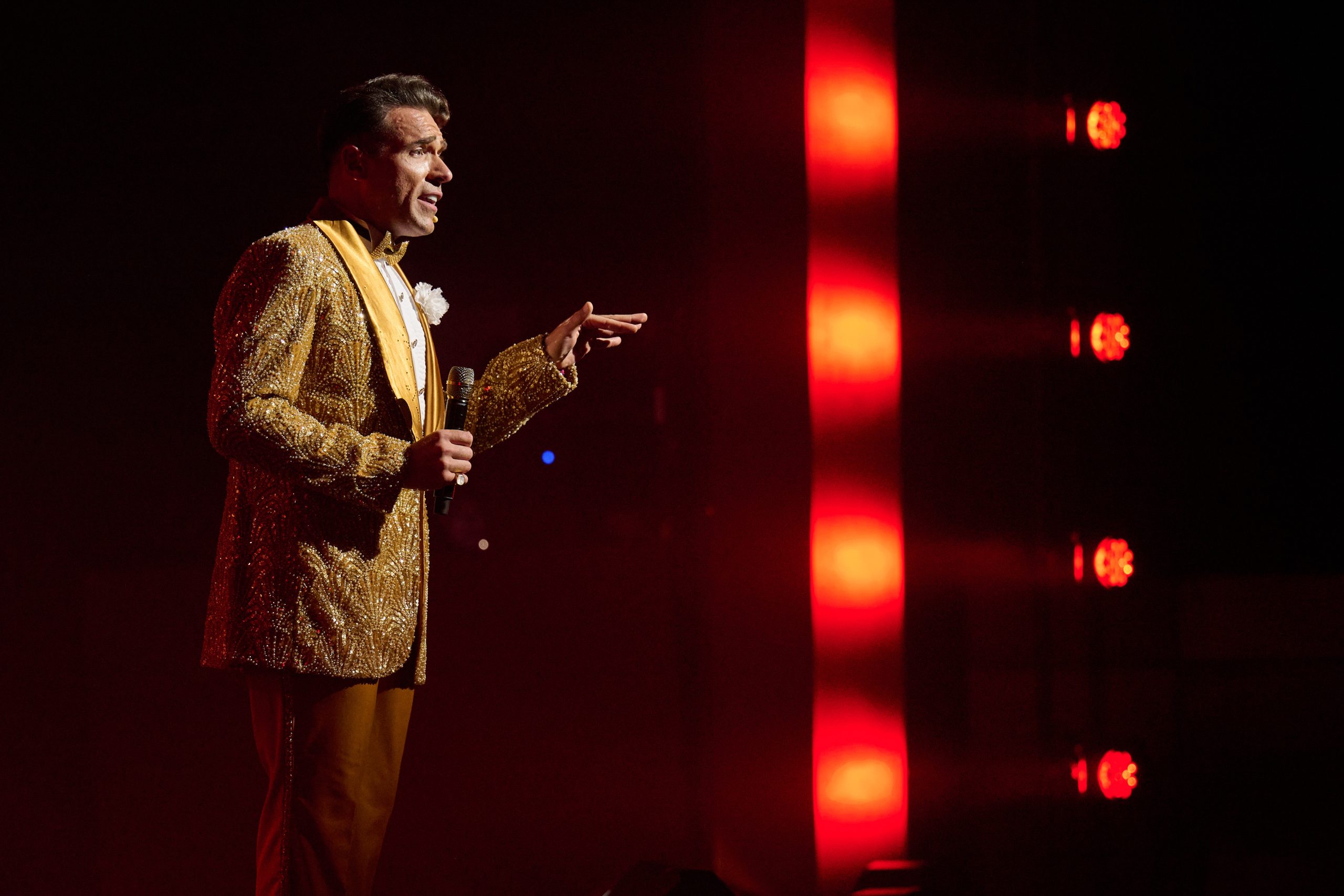
The only non-Robe fixtures came in the form of 13 Elation CUEPIX Panels that gave background light for the orchestra and two Robert Juliat ARTHUR follow spots, which were manually operated at the artist’s request. “Jonathan was very clear that he wanted a traditional follow spot with a human behind it,” Hauser stated, explaining the decision to go manual instead of automated. “He wanted this strong beam of light coming over the audience, and the Robert Juliat ARTHUR delivered it beautifully.”
Hauser operated the show from an MA Lighting grandMA3 onPC command wing, with no timecode to speak of. “I’ve worked with Jonathan for many years; he plays a big part in putting the creative together, and one thing he’s always been a fan of is that organic feel to his shows,” he revealed. “It ends up being a mixture of busking and creating a main cue stack, which is nice because it keeps it fresh and maintains that live feeling.”
In terms of highlights, rather than focussing on the biggest and most complicated looks, Hauser highlighted Rhapsody in Blue as a notable of example of how to let the music do the talking. “That was probably the most difficult song to light because we were torn between putting 100 cues in the song or just leaving it minimal so the music could speak for itself. We took the latter route, with only around 10 cues in the song, and it was simple yet very beautiful.”
Hauser also shared his opinions of L-ISA and explained how the audio can have a knock-on effect on the lighting. “The L-ISA technology had a major impact in what I do,” he said. “It meant that I didn’t have to concentrate as much on highlighting where solos were coming from, because the audience could hear exactly where the music was coming from anyway.”
Reflecting on the project, the LD stressed the importance of each department coming together. “It was really interesting to see all departments come together, with everything built around a little infrared beacon. When Jonathan walked to the stage left or stage right, his voice would follow, and so would the lighting and the video,” he commented. “When all departments come together, everyone gets excited about everything, and that’s important for any show. Departments are not operating individually of each other; you’re working together to make the show extraordinary.”
Photos: Lauge Sorensen