
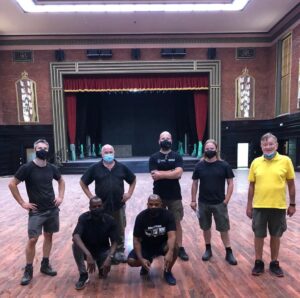
After a devastating fire in 2017, the Bloemfontein City Hall has been carefully restored to include the original building and décor elements that formed part of the sandstone structure originally completed in 1936. Roodt Architects was assigned as the architects and principal agents to oversee the refurbishment, reconstructing the ceiling from scratch and relying on old photographs to bring together the architectural details, lighting and colour scheme. DWR Distribution were commissioned to install the raw stage equipment and to provide a lighting and audio solution to complement the venue which, once officially opened, will be used by the community for events like school plays, pageants, ceremonies and banquets.
“The images of the burning City Hall started appearing on social media some time during the evening of 21 June 2017,” Anton Roodt of Roodt Architects recalls. “I could hardly believe my eyes when I saw the orange glow above the building with flames shooting up into the air, and fire trucks desperately trying to douse the flames. Videos clips showed cars and motorcyclists moving past the building as if unaware of the disaster taking place just 20 meters away from them.” Little did Anton know that soon after, he would delicately put together the broken pieces.
Roodt Architects was founded in Welkom in May 1952 by Anton’s father, Professor Leon Roodt, who relocated to Bloemfontein in 1970 when appointed as Head of the Department of Architecture at the University of the Free State. Since then, the firm has expanded to cover a range of projects from commercial, residential and urban design to heritage consulting, where some of the many restoration projects include the Free State Legislature (Fourth Raadzaal), the Old Presidency, Mapikela House, the National Afrikaans and Sotho Literary Museum and Prynnsberg Estate near Clocolan.
Meanwhile in the background, Anton was writing a book, launched in January this year and titled Weerlose meganika, which in English means ‘vulnerable mechanics,’ a novel that details the juxtaposition of bringing seemingly unrelated elements together. In a sense, that was the exact mindset Anton had to adopt when reinstating the City Hall – a careful blend of preserving history while considering modern technology.
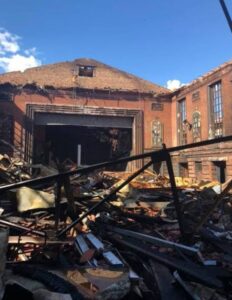
The greatest challenge was the reconstruction of items and elements destroyed by the fire. “The complete decorative ceiling had to be replaced, and there was the reconstruction of light fittings, door handles and decorative friezes and ventilation grills, items that all had to be re-manufactured,” Anton explains. “Finding suitable material such as the Burmese teak for the wooden windows, Zimbabwean teak for the sprung floors, as well as craftsmen who could reconstruct brass elements like handrails and ironmongery, proved a daunting task.”
At the same time, it was necessary to apply modern health and safety measures, the latest building regulations and other technological advances. “This means that more energy-efficient lighting was used, although the fittings are the same,” he explains. “Access to the stage had to be slightly modified to accommodate a chairlift for people with disabilities, security measures had to be included, while in the foyer we added additional lighting as it was never adequate before. Other items of modernization were also introduced prior to the fire, such as the upgrading of the public toilet facilities, that was executed by others. The air-conditioning system was replaced, and in that sense, modernized. The upgrading of the sound and stage lighting systems is a huge benefit. This will extend the functionality of the space dramatically and ensure that a whole new generation of citizens will enjoy the events that are presented here.”
After searching online for a suitable sound and lighting company, Anton came across DWR Distribution. “I was impressed by the installations that DWR executed elsewhere, and I contacted Rob Young from the company,” he describes. “Rob immediately understood what our needs were, and I sensed he was the right person to assist us with the project. He also gave us valuable assistance with the selection of stage curtains and general information regarding contemporary stage finishes. Despite the delays caused by the Covid-19 pandemic, when the DWR team became available, they quickly and efficiently installed the sound and lighting. What we, as architects, appreciate is that the equipment is as compact and unobtrusive as one could hope for.”
Rob Young recalls his first site visit to the City Hall. “It was a burnt-up shell filled with cinders and there wasn’t a roof. It was very sad to see. The brief was to implement modernised equipment but in keeping with what they had before. We were not to interfere with the ceiling as that was part of the old detail and so we worked around that. I could tell from the foundations that the theatre had a raked stage. In years gone by, and many people don’t know this, they used to build stages that sloped upwards, away from the audience. The back was higher than the front, and that’s why in theatre they speak of ‘back stage’ which is the back and further away from the audience and ‘upstage’ which is the front and where the actor is closer to the audience. Anton Roodt said he wanted to keep the stage as it was.”
Rob designed all the raw stage equipment consisting of bars, winches and curtain tracks and worked closely with the assigned electrical company. “We specified power points and the electrical contrator was really good. We wanted a walkway up in the roof for the cable runs, and everything went very well.” All custom bars were manufactured by DWR Distribution and the order included a motorized curtain track with curtains, hand winches, a pile wind hoist and motors, scenery bar and ladder lighting bar.
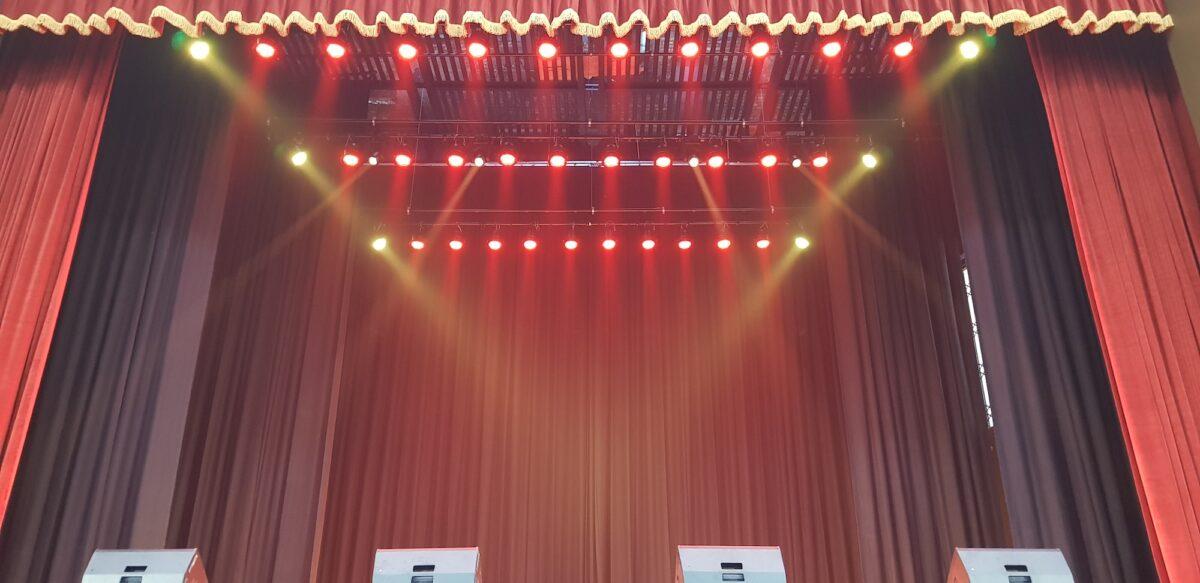
Consulting with colleagues Kevin Stannet, who specializes in lighting, and Jaco Beukes who focusses on audio, Rob came up with a solution to provide the necessary equipment for events in the venue.
“The lighting system includes 6 Robe Spikies, an LED fixture which can be used as a wash or beam and also provides a relatively hard edge to use as a special,” Kevin Stannett explains. “We also installed 48 Longman F4 Up for a general wash, and a user-friendly dot2 Core console, by MA Lighting, for control, which will be able to accommodate additional equipment if needed for a larger production.”
The audio entails a PA with left, right and centre configuration. “Each cluster has two Quest HPI 110 compact high-definition loudspeaker per hang,” Jaco Beukes explains. “Between each cluster is a HPI212S Passive High Powered Low Profile Sub-Bass, with four units in total, and in addition, four Quest QM450A monitors. The stero power amplifiers consists of four Quest QA3004 units. The system really sounds great. A DiGiCo S21 is found at FOH, which is simple and easy to use, while offering power to the engineer. As FOH is situated in a small back corner of the room, we also included two Quest MXC601 monitors for reference.” Furthermore, the audio includes the professional Audix range compromising of four AP61 wireless receivers, four OM5 Wireless handheld microphones, four Beltpack and two ADX10 Lavalier lectern microphones.
Two years after placing the order with DWR Distribution, bearing in mind that the world was facing the Covid-19 pandemic, the installation headed by Andrew Rodgers, Keith Pugin, Jaco Beukes and Kevin Stannett, commenced.
“The install went really smoothly,” said Keith Pugin. “I have to commend how everything was so carefully put together. On the side of the hall, as an example, they have delicate wall sconce lights, shaped like candles and each handmade. The building also has a modern twist. The roof lights are cleverly designed to look like a sky light, but it’s all LED. This means the room can either appear as though natural sunlight is streaming in from above, or the roof can change colour.”
Once the installation was complete, Anton Roodt was invited for a demonstration. “We were all hugely impressed by the quality of the sound, especially given the poor acoustic properties of the existing space,” Anton comments. “The whole project was dealt with in an efficient and professional manner. The highlight for us was the quality of the people we worked with. These include the representatives of the main contractor, the various subcontractors, many of whom executed work that required scarce skills, right through to companies representing cutting edge technologies such as DWR.”
The City Hall will offer citizens of Bloemfontein a space where they can congregate and a great space for public meetings, music concerts, school year end functions, dancing, wedding receptions, and almost any other gathering that one would find in a civilized society.
“When a project is pursued with dedication, experience, and above all, passion, then the vagaries of the building industry in South Africa, and even a world-wide pandemic, cannot derail its success,” said Anton. “Get the right people, and you will get the job done.”