
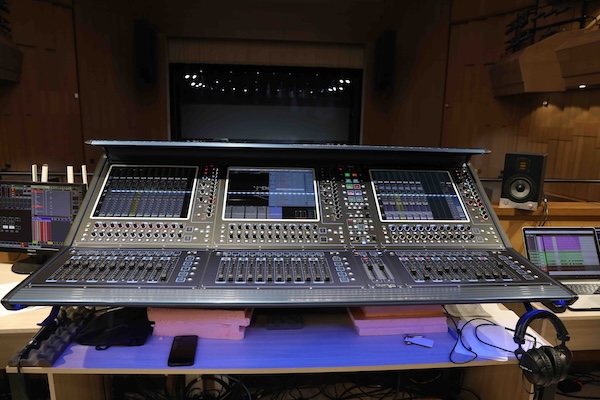
Almaty Theatre is a gem in Kazakhstan. Well-known for excellence in performance, the venue has undergone many technological enhancements over the last few years, including the recent purchase of a brand-new DiGiCo Quantum 338 T, installed by Samat show technic LLP.
The theatre’s nightly performances are not limited to a single genre and span a full spectrum of theatrical, dance and musical performance. Sound engineer, Roman Dvoretsky, explains that searching for a mixing console that is flexible enough to facilitate this range of performance styles, while delivering high channel counts, and crystal-clear audio could only end with the purchase of a Quantum 338 T.
“The heart of any musical theatre show is the console, and in our case, the DiGiCo QUANTUM 338 T” he says. “Sound Designer, Mikhail Sokolik, who came to our theatre to design the musical Juliet, prefers DiGiCo consoles, so when there was a choice, we chose the Q338! There are many consoles from other companies that could cope well with this task, but DiGiCo just does it better. There are a lot of functions that are very well suited to working with complex shows, a high channel count, and a large number of commands.”
It is not just the audio that is controlled by Dvoretsky. Thanks to the ability to send commands directly from the console, he can simultaneously fire corresponding lighting, video and stage-automation cues, intensifying the impact of the drama on stage.
“All control comes from here. We send MIDI and time code to the lighting console, so that we can fire cues with the music. We are also controlling certain aspects of video, too, so the footage changes exactly when we need it to,” he expands. “In addition to the console, we have several computers. The first one records a multitrack of absolutely every performance, plus a pre-mixed recording of the band, without vocalists, as well as a complete recording from the masters. This is for reference information and we use it for training and subsequent rehearsals. We can double check any technical issues that might have happened, such as radio-microphone issues.”
Dvoretsky can also manage playback from the mix position, offering another layer of audio automation and reliability. The playback system is delivered by two computers, networked to run in-sync. When Dvoretsky sends a MIDI command from the console, each computer completes a variety of tasks, from starting playback or click, to time code and other commands. If one computer breaks, he can simply switch to the back-up and continue working from the other computer. Much of this automation is controlled via Snapshots, and this ensures there is enough flexibility in the system to cope with the inevitable inconsistencies of live theatre.
“Snapshots help us to keep everything as similar as possible night after night,” he continues. “Everyone is human, and anyone can forget a phrase, or make a mistake. Automation is very helpful in providing a framework, or structure to the show. I have a single Snapshot that starts playback, timecode and a media command to the lighting console; it changes video content, and assigns the necessary channels to the DCAs. I can then use the DCA faders to control the microphones of the performers that participate in that number.”
Another feature of the console that is much appreciated by Dvoretsky and the team is its thoughtfully designed surface. Thanks to three high-resolution, 17-inch displays he can be sure that everything he needs to see is right where he needs it, with fully customisable surface placement.
“All consoles have layers, but on the Quantum 338, you can label each layer and immediately see where your microphones, drums, the rest of the band, and the effects are, etc. All these little things greatly affect the speed of workflow and on a musical, every second is precious. If someone comes up to me to ask why they haven’t heard the third person in the ensemble, by the time they ask, I’ve already missed the fourth person in the ensemble!”
The ability to design his own workflow and work in the way that suits him best means Dvoretsky can respond at speed and stay in control. It is a system that continues to work well for him and the team.
“Control is very customizable and for any show, this really helps our work. After using the DiGiCo, you can no longer imagine how you could work differently,” he concludes. “Previously, I worked with one screen and looked for everything somewhere on there. Now we have a Quantum 338, you can do everything in a second and see it all. It’s a real game-changer.”