
Latest software version introduces a highly anticipated reverb for every mix,
plus a safety limiter and ambience ducker for KLANG:kontroller
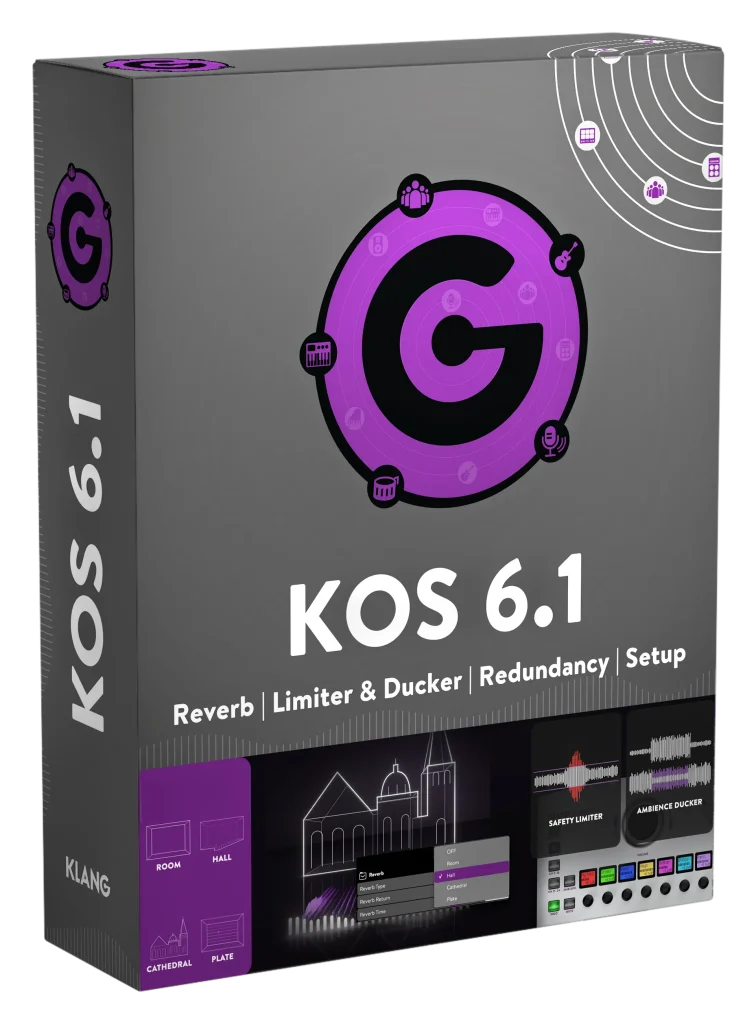
AACHEN, Germany – November 2026 – KLANG:technologies announces KOS 6.1, the latest update to its operating system and KLANG:app, which gives every mix its own reverb. The update also adds a safety limiter and an ambience ducker to KLANG:kontroller.
“Reverb has long been one of the most requested features from musicians and monitor engineers,” says KLANG Co-Founder Dr. Pascal Dietrich. “Immersive mixing has already taken away the isolation musicians used to feel on stage, and spatial positioning has let them turn their in-ears down without losing detail. Now, with KOS 6.1, every mix gets a room of its own, running directly on the processor: a singer can hear their voice in a cathedral while the drummer keeps a tight room around the kit. Add a safety limiter that is on before anyone has to think about it, and you get exactly what KLANG has always stood for: lower levels, better mixes.”
Free of charge, the new reverb runs directly on the KLANG:konductor, KLANG:vokal, DMI-KLANG, and KLANG:1pro processors. Every mix can choose from four reverb types—Room, Hall, Cathedral, or Plate—each with its own adjustable time, return level, and four-band EQ. A reverb send on every channel lets the vocal sit in the room while kick drum and bass stay dry.
Monitor engineers set up each mix’s reverb in KLANG:app, and musicians can adjust their own reverbs on KLANG:kontroller or in KLANG:app. Existing shows load with the reverb off, so updating never changes a mix that’s already signed off.
Immersive mixing already lets musicians hear every source clearly at a lower volume, because instruments no longer mask each other in the middle of the head. A room around the mix makes it sound even more like a real stage, so there’s less reason to push the level up to feel the music.
KOS 6.1 also brings a new safety limiter and an ambience ducker to KLANG:kontroller. The safety limiter is on by default and protects the musician’s ears by catching sudden full-scale bursts, such as a dropped cable or a feedback spike, before they reach the in-ears. The ambience ducker lowers the audience mics while the band plays and brings the crowd back between songs.
In redundant DiGiCo systems, every KLANG:kontroller and KLANG:app now follows the console; one macro, or the console’s own switch to its backup engine, moves them all to a backup KLANG processor, each musician on their own mix. Without a DiGiCo console, one Action Button in KLANG:app does the same.
Ultimately, KOS 6.1 makes KLANG smoother every day: easier to set up, faster in operation, with network switches that list every KLANG unit by name and port, and Dante patching for KLANG:vokal right from KLANG:app.
KOS 6.1 is available now as a free public preview for all eligible KLANG processors and KLANG:kontrollers. To ensure continuity for active productions, the preview comes first: KOS 6.1 will replace the current KOS 6.0 as the official release by the end of November.
For full details and to download, visit: www.klang.com/pr-6-1