
The Italian company combined three generations of L-Acoustics line source technology, L1, K1 and V-DOSC, across nine delay lines reaching some 580 metres, on a bare site with a hospital directly behind the stage and strict noise limits at the boundary.
This summer, seven years to the day after his first stadium show, Ultimo played to 250,000 people on the open plain at Tor Vergata, on the south-eastern edge of Rome. La Favola per Sempre sold out in three hours and stands as the largest ticketed concert ever staged in Italy.
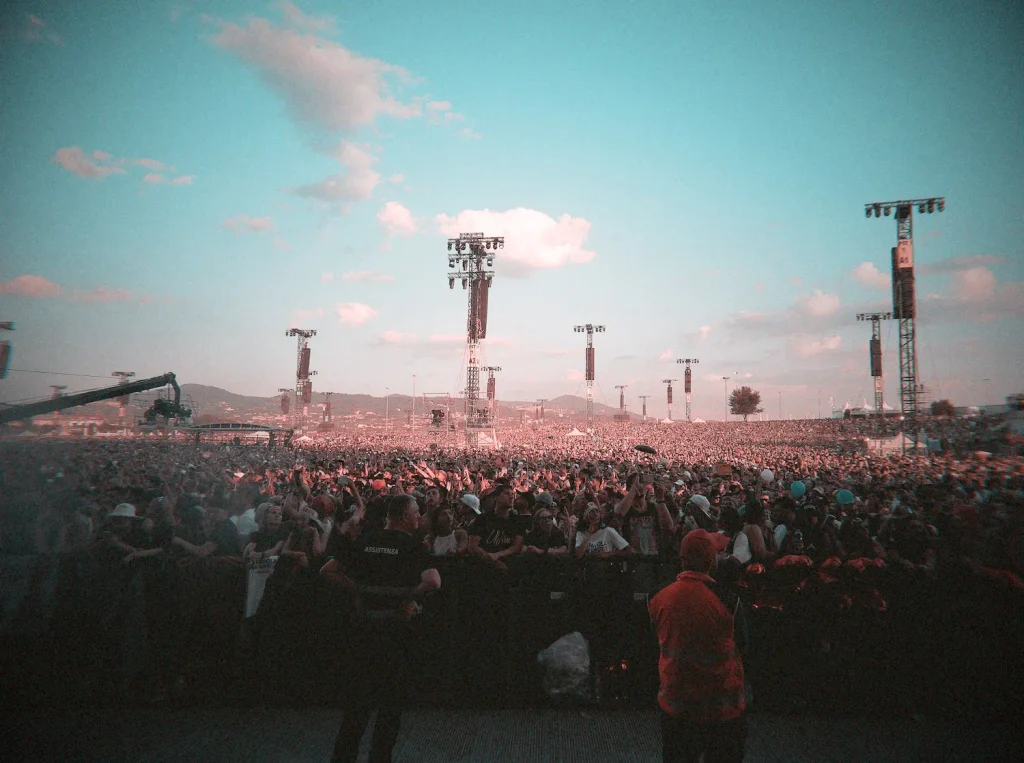
Ultimo is Niccolò Moriconi, a singer-songwriter from Rome. He released his first single in 2017, won the newcomers category at Sanremo in 2018, and by July 2019 was filling the Stadio Olimpico for more than 63,000 people. At 23 years old, he was the youngest Italian artist to headline a stadium. For his record-breaking show at Tor Vergata, the audience site was split into six areas, one for each of his albums, and the show ran to 29 songs.
The plain at Tor Vergata holds no permanent event infrastructure: no power, no access roads, no load-in routes. It has taken very large crowds before, most recently more than a million young people for the free, non-ticketed Jubilee of Youth with Pope Leo XIV in August 2025. Everything this show needed was brought in and built: a 140-metre stage on 34 towers rising to 33 metres, 2,500 square metres of LED, and a field of delay towers stepping back across the audience. Directly behind the stage stands the Policlinico Tor Vergata teaching hospital.
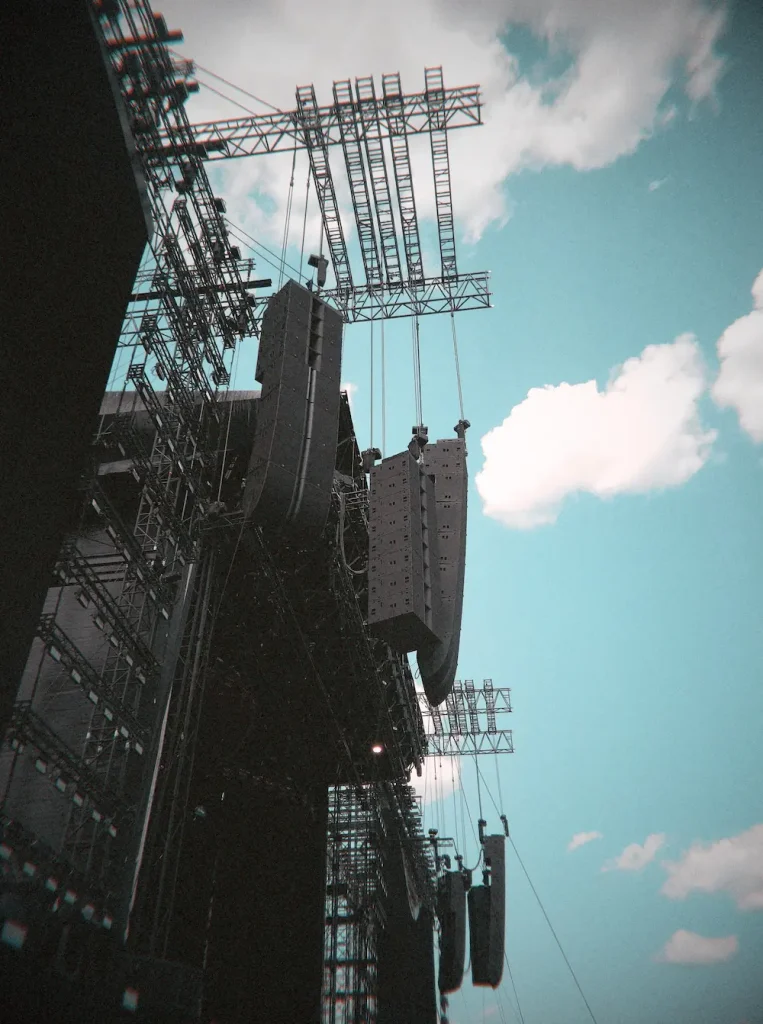
FOH engineer Andrea Corsellini first brought in L-Acoustics Certified Provider Agorà to produce a coverage preview of the area, then asked the Italian company to take the project through to delivery. Agorà specified three generations of L-Acoustics line source technology for the job: the newly launched L1 with CS1 subwoofers on the main system, K1 and K2 through the nearer delays, and V-DOSC at the far end of the site. Agorà is also working with Vivo Concerti and the University of Rome Tor Vergata on a research programme studying sound propagation and acoustic impact around an event of this scale.
For Agorà, which has worked in large-scale live concert production for many years, Tor Vergata was the largest ticketed event in the company’s history. The artist’s strong focus on audio gave the sound system an unusual degree of priority within the overall production, which allowed Agorà to propose L1 for both the main system and the sidefills. Corsellini tested the system at Agorà’s warehouse beforehand, was immediately convinced by the result, and presented it to the artist’s management.
Agorà has worked with L-Acoustics since the V-DOSC era and took part in the pilot phase for L1, making the concert an opportunity to put the new flagship to work in a real-world production of exceptional scale.
L1 and CS1 Cardioid Low End Preserve Quiet at the Hospital Behind the Stage
The brief set two requirements against each other. The main PA had to carry the scale and impact of the biggest concert ever staged in Italy, and it had to do so while holding to noise limits behind the stage, where the hospital sits, and at the site boundary. Ultimo’s repertoire is primarily pop, but his shows carry a significant amount of low-frequency energy, and the artist’s team, very demanding on audio quality, set one overriding goal: uniform, consistent sound from the front of the audience to the furthest delay positions. Cardioid low-frequency control was the route to both. L1 and CS1 carry a cardioid low-frequency architecture giving up to 26 dB rejection onstage, offering a choice of cardioid, supercardioid and side-rejection presets.
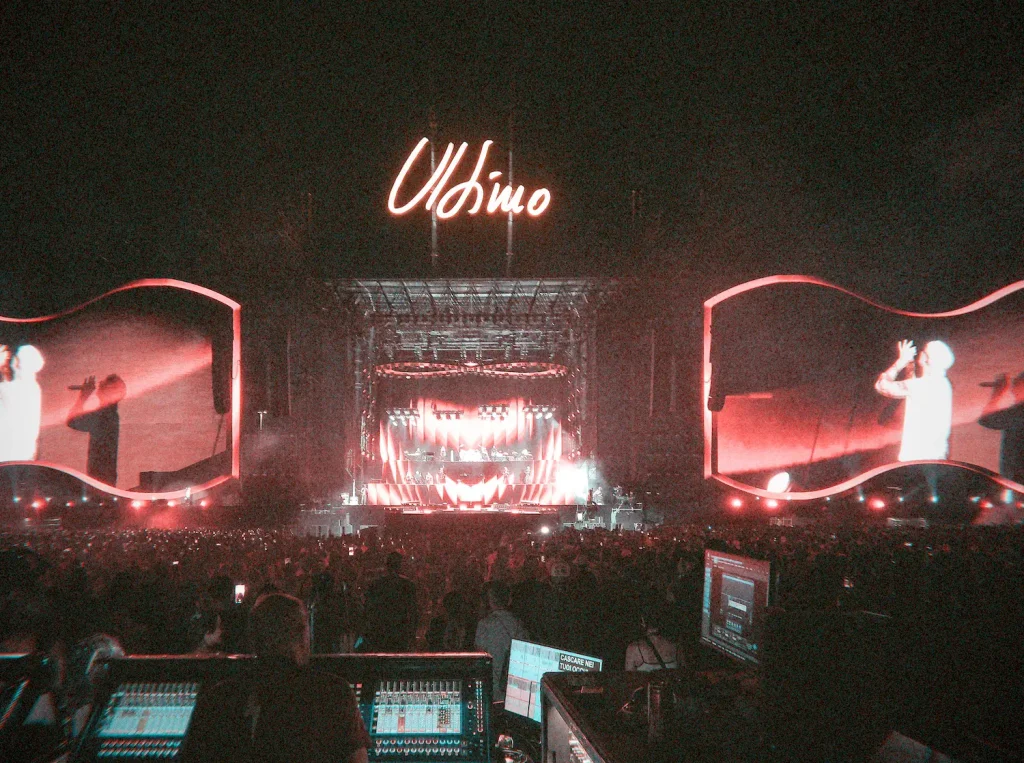
“The L1 main system was a game changer, extremely powerful and good sounding,” says Agorà FOH assistant Remo Scafati. “With its cardioid pattern, coupled with the CS1 subs, it helped us a lot with the challenge of noise control.”
The site itself was the other half of the problem. “The venue and the audience were huge, and the site wasn’t equipped from an infrastructure point of view,” says Scafati. “The design and preparation took a lot of time and effort.” Load-in and the movement of equipment across the plain were slow, and the summer weather ran from scorching heat to sudden storms.
Soundvision Predicts Coverage and Spill Across 580 Metres
Agorà modelled the deployment in L-Acoustics Soundvision throughout. With the hospital behind the stage setting a hard limit on rearward energy, and the furthest delay line sitting some 580 metres from the stage, Soundvision was used to predict coverage across the depth of the site before anything was rigged. Antonio Paoluzi, who designed the delay system, also developed his own software to recalculate delay times according to changes in temperature and humidity. The design was split into two projects, partly for system management reasons and partly because the number of amplified controllers exceeded the maximum that a single LA Network Manager session can handle. “Soundvision is now a very precise tool for predicting coverage and delay times, and it was particularly useful in anticipating coverage challenges across the different areas of the site,” says Paoluzi.
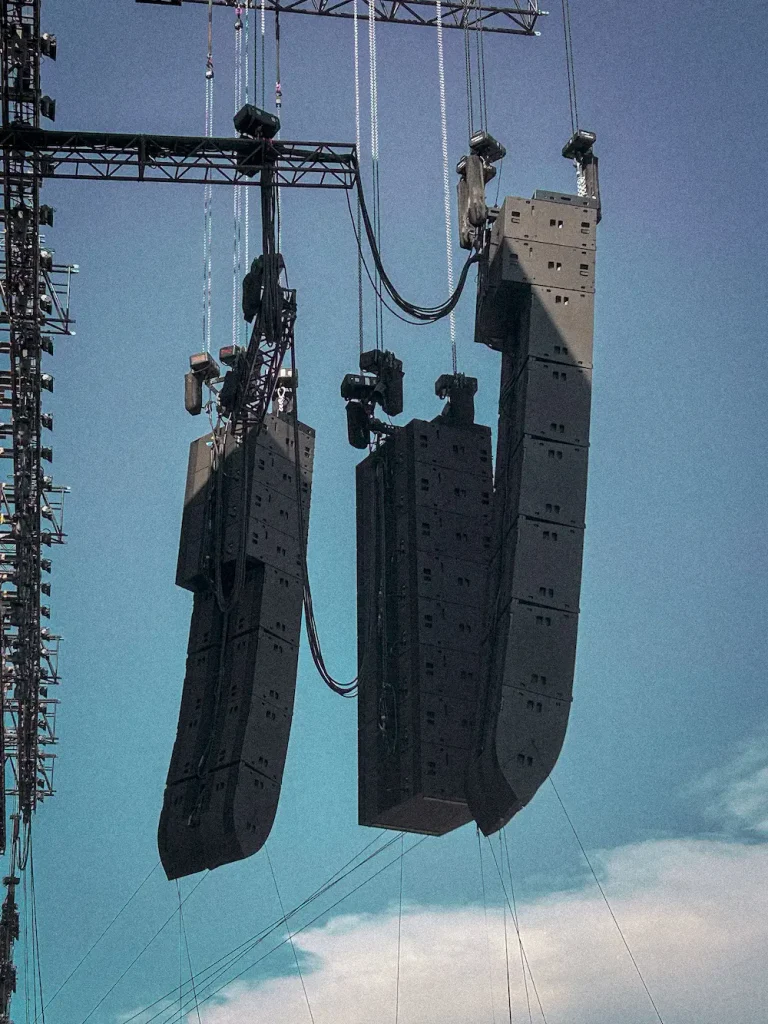
L1, CS1 and K1 Build the Main System
The main system centred on four L1 hangs, two main and two side arrays, each with an L1D at the bottom for near-field coverage and CS1 flown above. A further eight CS1 were flown centrally, and 63 KS28 were ground-stacked in threes in an arc across the front of the site. Front-fill came from Kara II and A15 across the width of the stage, with an additional K1 hang extending coverage to one side. Each main hang comprised two CS1, five L1 and one L1D, while each side hang comprised four CS1, three L1 and one L1D. On stage right, an additional side system of 14 L1 covered a large VIP grandstand. The system was run by LA7.16 amplified controllers.
K1, K2 and V-DOSC Carry Nine Delay Lines
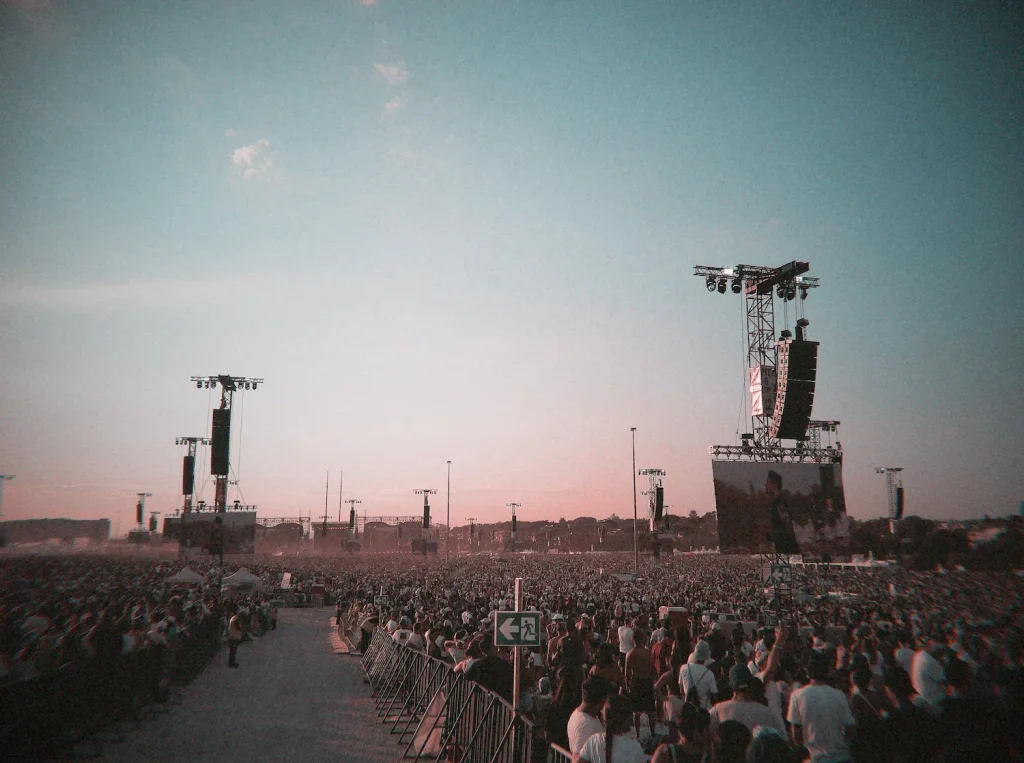
The delay design ran across nine positions stepping back through the site. The nearer lines used K1 and K2, moving to K2 further back, then to V-DOSC at 460 and 520 metres from the stage. The final line, at some 580 metres, returned to K1 to close out the coverage. KS28 supported the low end at each delay position, and Kara II covered the grandstand.
The whole system ran on Milan-AVB, with primary and secondary networks over a star-topology Luminex network made up of a central hub plus ten primary and ten secondary nodes. Each tower was fitted with an L-Acoustics LA-RAK II AVB and an LS10 switch. An Optocore network fed the amplified controllers with AES as an automatic fallback, and, given the scale and complexity of the site, Agorà added an analogue feed as a third layer of redundancy for disaster recovery.
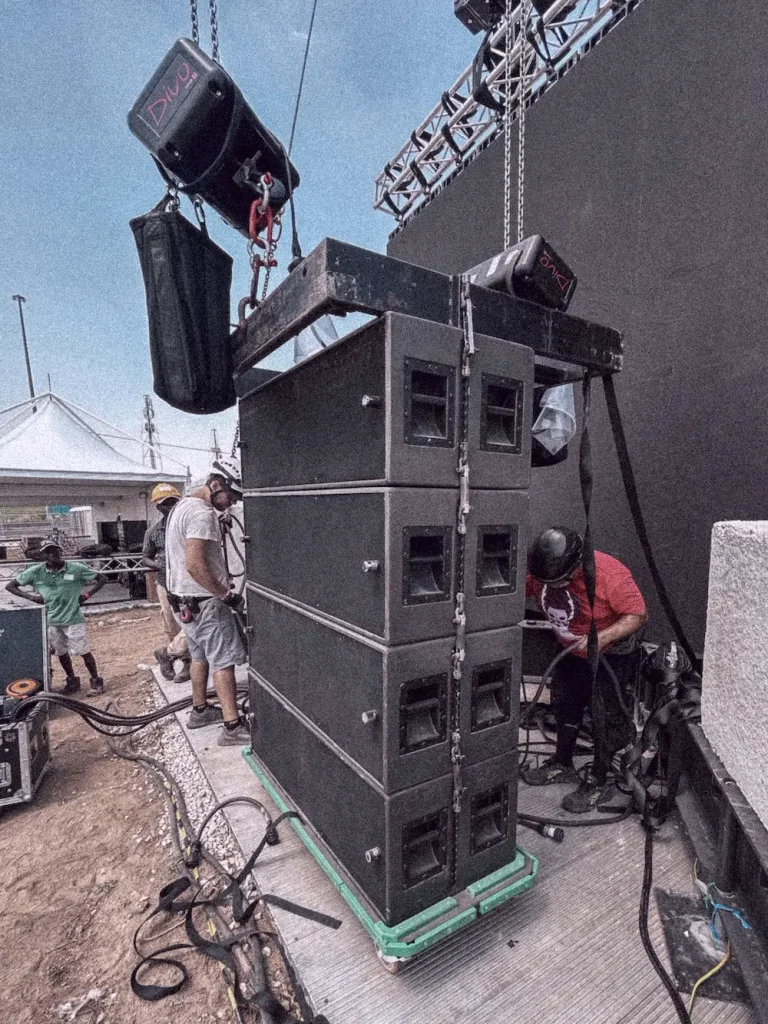
“The biggest operational challenge was the delay system,” says Valerio Motta, Agorà technical manager. “Given the enormous size of the venue, the intense working schedule and the extreme heat, getting everything into place and properly optimised was far from easy, but the final result made all the effort worthwhile.”
Antonio Paoluzi was the system engineer responsible for the delay chain, with Luca Nobilini on the main system. Agorà also drew on support from L-Acoustics regional application engineer for EMEA South, Tom Laveuf, through deployment, tuning and the show itself. “They have always been close and available to help us, always in an atmosphere of professionalism and friendship,” says Scafati.
L1 and CS1 Deliver Impact at the Front and Control at the Back
“It is one of the best-sounding systems I have heard in my life, and the two system engineers, Luca Nobilini on the main system and Antonio Paoluzi on the delays, achieved an outstanding result. What we achieved for this historic concert is only possible through great teamwork and remarkable technical know-how,” says Corsellini. “This was truly a show for the books.”
Corsellini also singled out L-Acoustics Source Intelligence as a real game changer. Feedback from the artist, his management and the other professionals involved praised the clarity, definition and overall impact of the sound.